
Lenexa Tree Removal handles tree trimming and pruning across Lenexa, KS, serving surrounding cities including Shawnee, Olathe, Merriam, De Soto, Edwardsville. Twenty years of pruning and removals on the same streets is what lets us tell you which cut a tree actually needs instead of quoting whatever was asked for.
Most trimming estimates fail on vocabulary. Crown cleaning, crown raising, crown reduction and thinning are four different operations under ANSI A300 with four different prices, and an estimate that says trim the tree has committed to none of them. Ours names the pruning type, the target clearance and the limbs coming out.
We also do not top trees, and that is worth saying before the price rather than after. A topped crown answers with weak regrowth on decaying stubs and becomes a worse hazard within a few seasons, so the work has to be bought twice. Reduction back to live laterals costs more once and does not come back.
The Pruning Types, Named Correctly
Crown Cleaning
Crown cleaning removes the dead, dying, diseased and broken wood and the crossing limbs that are wearing on each other. It changes the shape of a tree very little and changes its risk profile a lot, which is why it is the most commonly right answer and the one people are most often talked out of in favor of something bigger.
Crown Raising for Clearance
Raising lifts the lower limbs to give clear height underneath - over a walk, a drive, a roof or a lawn. The work is done by removing whole lower branches back to the trunk in sequence rather than by shortening them, because a shortened lower limb sprouts and drops straight back into the space you just cleared.
Crown Reduction and Thinning
Reduction shortens the outer edge of a crown back to live lateral branches large enough to take over, which keeps the tree’s outline and lowers the leverage on a weak union. Thinning selectively removes interior branches to reduce density.
They are often confused, and the difference matters on a bill: reduction is slow, cut-by-cut work on the ends of a canopy, while over-thinning a tree strips its interior and produces a lion-tailed crown with all the weight at the tips - the opposite of what was wanted.
Clearance Pruning Around Streets, Walks and Wires
Sidewalk and Street Clearance
The standard around here is eight feet of clear height over a sidewalk and thirteen over a street. Lenexa will trim a right-of-way tree itself where it causes a sight, sign or sidewalk obstruction or where low-hanging or broken branches hang over the roadway - but the city also tells homeowners the right-of-way tree in front of their house is theirs, so this is usually the owner’s work.
The Service Drop, and the Ten-Foot Rule Above It
The line running from the pole to your meter is the customer’s responsibility under Evergy’s own published rule, and because Evergy publishes no line-drop or disconnect service on the Kansas side, that span is worked around an energized conductor. Anything on the primary above it belongs to the utility, whose assist normally covers overhanging branches and limbs within ten feet of energized conductors and leaves the debris at the worksite.
Signage, Lighting and Sight Lines on Commercial Sites
On a business park, a retail frontage or an apartment community the clearance that matters is usually a monument sign, a light standard, a camera or a truck route. That work is specified in feet and photographed, because a facilities manager needs a record that the clearance was achieved rather than an assurance that the tree was trimmed.
Structural and Restoration Pruning
Structural Pruning While the Cuts Are Small
Structural pruning removes competing leaders and establishes a single dominant stem while the wounds are still small enough to close over quickly. On a young tree that is an hour of work; on a forty-year-old one the same correction means removing limbs large enough to leave permanent openings, so the value of this service is almost entirely in doing it early.
Restoring a Topped or Storm-Broken Crown
A tree that was topped, or that lost a large part of its crown in a wind event, can often be brought back over several visits. Restoration selects the strongest of the regrowth shoots at each stub and removes the rest, so one leader per stub develops properly attached wood instead of a cluster of competing sprouts on decay.
It is deliberately slow work spread across years, and we say up front how many visits it will take. The alternative is not one big pruning job; the alternative is a removal in a decade.
When Hardware Beats Cutting
Some trees do not need less crown, they need the union held. A codominant stem with included bark is a seam rather than a weld, and taking weight off the ends only delays it. A cable set high in the crown with brace rods across the union is often the cheaper and better answer, and we will quote that instead of a reduction that was never going to solve the problem.
Timing: When to Prune What
The Dormant Season for Most Species
Most structural and reduction pruning here happens in the dormant season, when the architecture is visible, wound closure starts promptly with spring growth, and the crew is not working blind through leaf cover. Dead wood and genuine hazards come out whenever they are found, in any month.
Oaks and the Spring Window
Oak wilt moves between trees through grafted roots as well as by beetles attracted to fresh wounds, so oaks are kept out of the high-risk spring window as a matter of routine. Where an oak has to be cut in that period for a real safety reason, the cut is made and treated the same day rather than left open.
Pines, and the One Deadline in This Trade
Pine is the failing screen conifer around here and pine wilt is the only job in this trade with a published deadline. K-State Research and Extension directs that an infected pine be cut down as soon as possible or by May 1 at the latest, with April 1 the better target, cut to the ground with no stump left, and the wood chipped or burned immediately rather than saved for firewood.
How We Prune
1. Agree the Pruning Type Before the Price
Every estimate names the operation - cleaning, raising to a stated height, reduction, thinning, restoration - and says what is coming out and roughly how much of the live crown that represents. That sentence is what you are actually buying, and writing it down is what stops a crew and a client remembering the same visit two different ways a month afterward.
2. Work on Rope or From a Lift, Not on Spikes
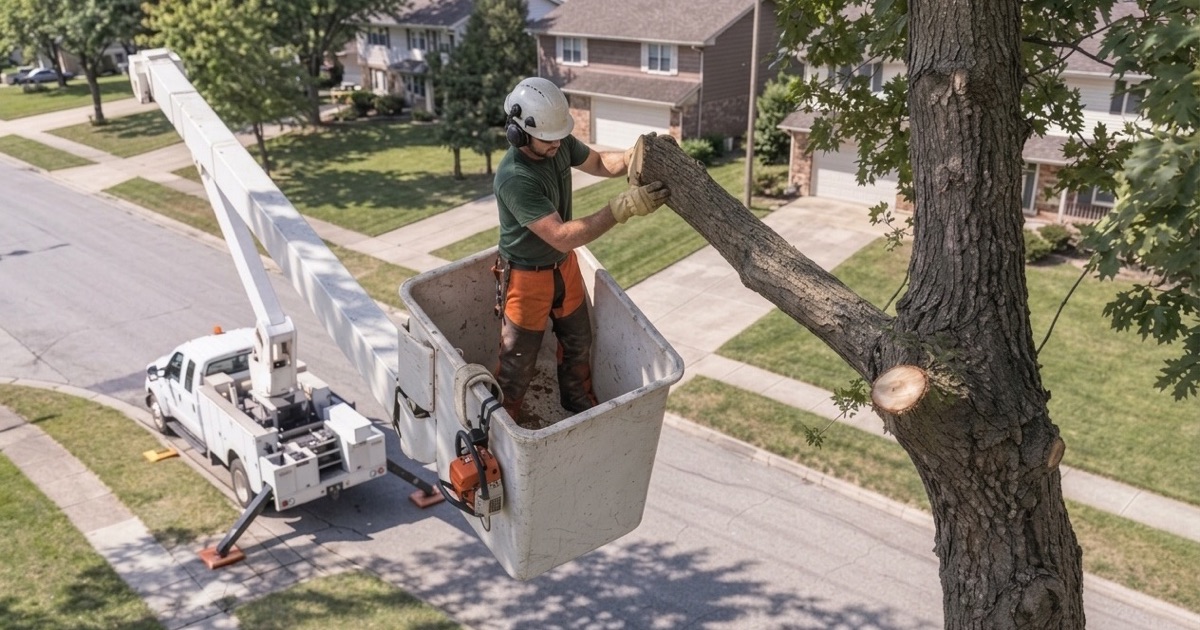
A tree that is staying does not get climbed on spikes, because every step punctures the cambium and leaves a column of wounds up a trunk we were paid to keep healthy. Work is done on rope and saddle or from a lift, and on tight lots a spider lift tracks through a gate onto ground a bucket truck could not reach without sinking into the lawn.
3. Cut to the Collar, Every Time
Cuts are made just outside the branch collar so the tree can seal over them - not flush to the trunk, which removes the tissue that does the sealing, and not leaving a stub, which cannot seal at all and simply decays inward. No wound paint either, since it traps moisture rather than helping, with the single exception of an oak cut during the high-risk season.
4. The Brush Leaves With Us
Everything cut is chipped and hauled on the same visit. Lenexa’s curbside rule takes bundles no longer than forty-eight inches, under eighteen inches in diameter and sixty-five pounds each, six per pickup, which will not absorb even a modest pruning job - so the material goes on the truck, the gutters and the roof valleys get cleared of what fell into them, and the site is left raked.
- Insured, Proof Provided
- 20+ Years in Johnson County
- Free Written Estimates