Tree Removal in Lenexa, Priced Against the Tree

Insured crews, written estimates that name the tree and the cleanup, and same-day response when something is on a house, a car or a service line.

Lenexa Tree Removal has worked trees in Lenexa, Kansas for more than twenty years: removals, stump grinding, trimming and pruning, land and lot clearing, emergency and storm damage work, planting, shrub and hedge removal, disease treatment, crane-assisted removals, and the property-line jobs where the tree is only half yours. Our crews run Johnson County every day and cross State Line Road into Missouri most weeks.

Every removal is quoted against what the tree is actually doing - its lean, its defects, what sits under it and what has to be rigged past - and never by the hour. The estimate is written, it names the tree, the method and exactly what cleanup is included, and proof of insurance is handed over before a saw comes off the truck.

When a tree is on a house, a car, a drive or a power service, we respond the same day. When a tree can be kept instead, we say so and price both ways, because a homeowner who is told to cut a tree that did not need cutting only finds that out afterward.

Get Your Free Quote

Fast response • No obligation

So we can reach you about your request.

So we can send you a confirmation after you submit this inquiry form.

  • Insured, Proof Provided
  • 20+ Years in Johnson County
  • Free Written Estimates

What we do

Our Services

Tree removal and tree care for Lenexa, Kansas

Worker on a footed ladder sighting an included-bark union high in a shagbark hickory on a Lenexa front lawn.

Arborist Tree Risk Assessment

A documented arborist tree risk assessment for Lenexa properties, rating what a tree is likely to do, what it can reach, and what it would cost.

Worker sweeping a grinder wheel across the face of a red oak stump in a Lenexa back yard.

Stump Grinding

Stump grinding across Lenexa, KS, with the depth the wheel can actually reach explained up front and the grindings hauled out rather than left behind.

Worker in an aerial bucket taking the weight of a pin oak limb butt he has just cut over a Lenexa street.

Tree Trimming

Tree trimming and pruning in Lenexa, KS, specified by pruning type rather than by the vague instruction to cut the tree back.

Worker guiding a grapple arm onto cut eastern red cedar stems at the edge of a Lenexa lot being cleared.

Land Clearing

Land and lot clearing across Lenexa, KS, cleared to the plan the city will actually review rather than to whatever the fence line suggests.

Worker drawing a choker strap under a windthrown eastern cottonwood beside a Lenexa house.

Emergency Tree Removal

Same-day emergency and storm damage tree removal in Lenexa, KS, worked in triage order with the utility called before anybody touches the tree.

Worker breaking the wall of a planting pit with a mattock beside a new sugar maple on a Lenexa front lawn.

Tree Planting Service

Tree planting and transplanting in Lenexa, KS, with species picked for what survives here and the root flare set at grade, not buried.

Worker pulling an arborvitae hedge stem cluster out of a Lenexa foundation bed after the tops are off.

Shrub And Hedge Removal

Shrub, hedge and brush removal across Lenexa, KS, taken out roots and all, with the debris on our truck rather than at your curb.

Worker pulling mulch back off the buried root flare of a declining white ash on a Lenexa lawn.

Tree Disease Treatment

Tree disease treatment and plant health care in Lenexa, KS, starting with a diagnosis rather than with a spray somebody sold at the door.

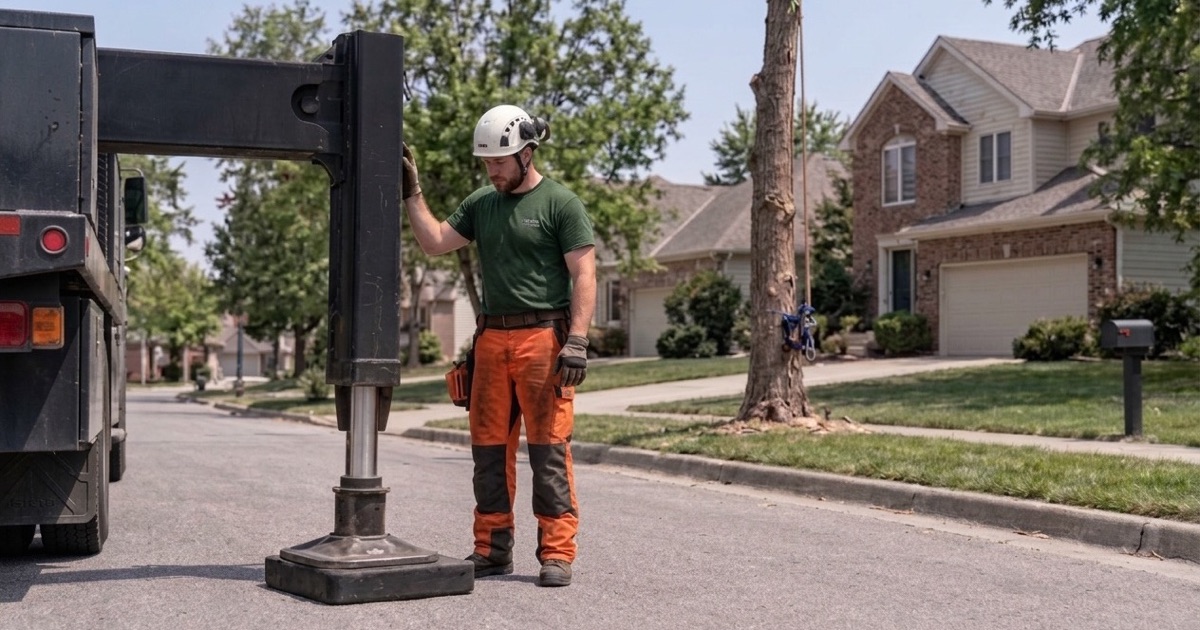
Worker steadying an empty crane hook block at chest height beside a sycamore in a Lenexa cul-de-sac.

Crane Assisted Tree Removal

Crane assisted tree removal in Lenexa, KS, for trees with nowhere to fall and nothing beneath them that can take a hit.

Worker rolling out a tarp along a Lenexa boundary fence before a black walnut limb is taken back to the line.

Neighbor Tree Removal

Property line and neighbor tree work in Lenexa, KS, with the legal question settled before the saw starts rather than argued over a fence afterward.

What Twenty Years of Tree Work in This Metro Is Worth

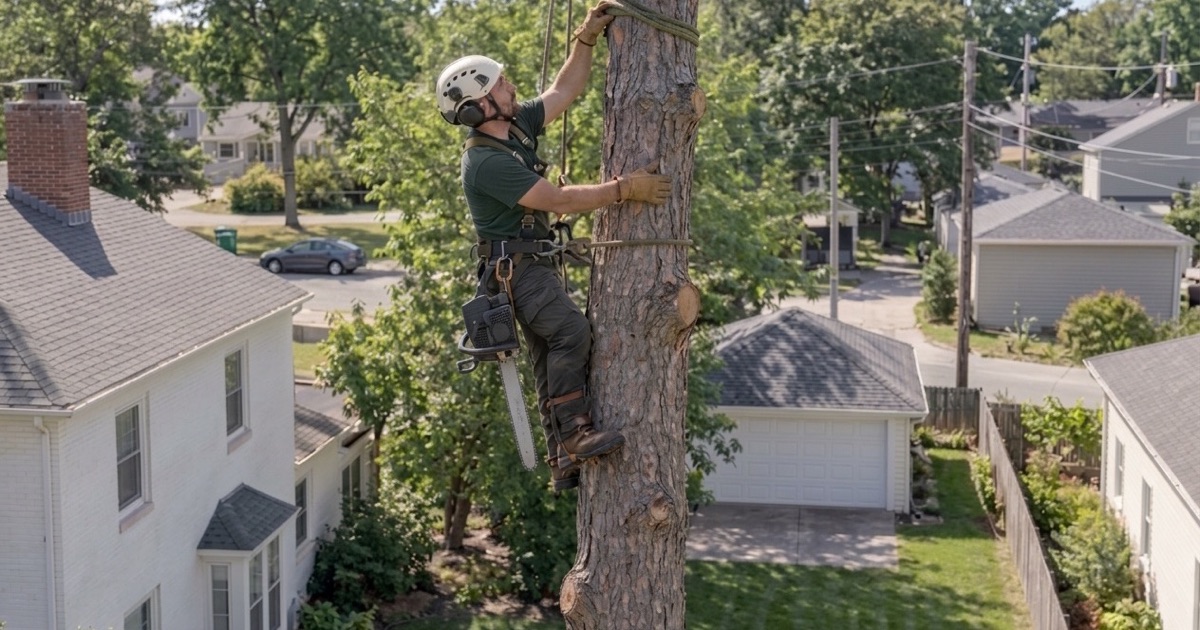
Climber hanging the anchor sling high on a white oak spar above a narrow Old Town Lenexa back yard.

Twenty Years of Removals in Johnson County

More than twenty years of climbs, removals and storm calls across Johnson County and over the state line means the judgement calls are already made: which species fail at which age on this ground, which lots take a crane and which take a spider lift, and which jurisdiction answers a right-of-way question differently from the one next door.

Insured, With the Certificate in Your Hand

Tree work is the corner of the trades where an uninsured crew costs the property owner rather than the contractor. We carry insurance for tree work and hand over proof of coverage before any equipment comes off the truck, so the certificate is something you have read rather than something you were told about over the phone.

The Credential That Actually Exists Here

Kansas licenses nobody to cut trees and Johnson County’s contractor program reaches structures only, so nobody working in this city can honestly advertise a license for tree work. Lenexa’s own homeowner page says to contact insured contractors with certified arborists on staff, and those two things are exactly what is worth checking.

Why Choose Lenexa Tree Removal

Written Scope, Named Tree

Every estimate names the individual tree, the removal method and the exact cleanup included, because a verbal number invites the argument about whether the stump, the brush or the log rounds were ever inside it, rather than leaving a homeowner to discover on the day that haul-away meant the chips and not the trunk.

The Right-of-Way Answer, Not a Guess

Lenexa tells homeowners the right-of-way tree in front of the house is theirs, that the strip typically runs eleven to fifteen feet back from the curb, and that no replacement is required when one comes out. No two cities around here answer that the same way, so we confirm the jurisdiction before quoting rather than importing the rule from the city across the road.

Crane and Lift Access for Tight Lots

Never assume a bucket truck reaches it. Nearly forty-four percent of Lenexa’s housing is attached or multifamily and much of the newer stock sits on narrow lots over engineered fill, so we bring crane or spider-lift access where the drop zone is a neighbor’s roof, rather than dismantling a tree over ground that will not carry an outrigger.

The Debris Leaves With Us

Lenexa’s curbside rule takes bundles no longer than forty-eight inches, no more than eighteen inches across and under sixty-five pounds, six of them a week - nowhere near one removal. Our trucks take the wood, the brush and the chips out with them and leave the site rakeable, so what your private hauler will accept never becomes your problem.

Save It or Remove It, Priced Both Ways

No tree here gets condemned to justify a larger invoice. Where a stem can be cabled, a crown reduced or a root flare excavated instead, we price the treatment beside the removal and let the numbers argue, rather than quoting the removal alone and letting a repairable tree look like the only option on the table.

Emergency and Storm Tree Work

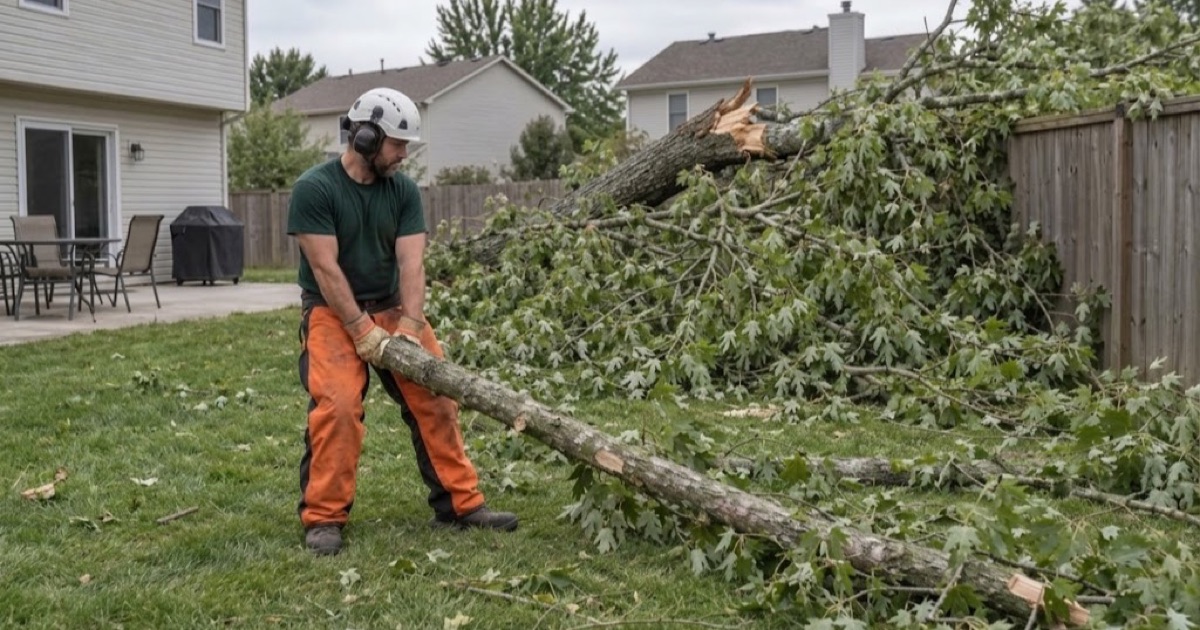
Worker dragging a cull log clear of a snapped silver maple stem in a Lenexa back yard after a wind storm.

Emergency Tree Removal in the First Hour

A tree on the house or the car is a sequence rather than a single phone call: get everyone out from under the load, leave the tree exactly where it is, and photograph it before anything moves. If a conductor is involved, Evergy’s own instruction is to call 911 first and then Evergy at 888-544-4852. We take it from there and rig the load off the structure rather than pulling it off.

Wind-Snapped Crowns and Hanging Limb Removal

The National Weather Service office at Kansas City and Pleasant Hill titles the July 14, 2023 event a wind storm: 89 mph was measured just west of this city, roughly 200,000 customers lost power and about 60,000 were still out the following day. Wind at that order snaps crowns and leaves hangers suspended in the canopy, which come out on rope and friction device rather than by shaking the tree.

Ice-Loaded Limbs and Winter Breakage

The same office records the February 5-7, 2019 ice storm across all of eastern Kansas at one-eighth to one-quarter inch of accretion, which is enough to bring brittle wood down. The Johnson County extension service attaches ice caveats to three trees it otherwise recommends - river birch, lacebark elm and sweet gum - and those are the ones the winter calls come in on.

Storm Response Through Tornado Season, April to June

The Weather Service records a May 19, 2024 squall line across Johnson County that produced four brief tornadoes, and spring is when this work stacks up. We hold crew capacity through the season rather than booking it out on scheduled pruning that could just as easily move to July, because a storm call that has to wait three days is not an emergency service.

Trees on the Line: Evergy, BPU, Gardner Energy and FreeState

Four utilities answer this question differently inside one metro. Evergy leaves its clearance debris at the worksite and needs the owner’s signed permission to remove anything over four inches; the Board of Public Utilities in Kansas City, Kansas will lower a service line for a fee through its Line Drop Service; Gardner runs its own city electric utility; and FreeState Electric Cooperative serves parts of Leavenworth and Douglas counties.

Storm Tree Removal at an Apartment Complex or Rental Property

Lenexa carries one of the metro’s larger business-park and multifamily concentrations, where grounds work is a common-area line item reconciled annually rather than a distress purchase. We quote storm work for property managers against that reality, with the scope, the access route and the debris destination written down in a form that goes straight into the file.

When Homeowners Insurance Pays for Storm Tree Removal

Coverage generally follows damage: a tree that strikes an insured structure is a different claim from a tree that fell in the open yard, and debris removal is one of the expenses policies treat inconsistently. The Kansas Insurance Department also flags a separate wind and hail deductible at one to two percent of the structure’s insured amount, which is the figure that surprises people. We write estimates an adjuster can read line by line.

Emergency Stabilization When Removal Is Not the Right Call

Not every storm-damaged tree has to come down that night. A split stem can be drawn together with cable and brace rods, a torn limb cut back cleanly to a lateral, and the tree reinspected once the ground has dried out - which is the better answer far more often than a same-day removal booked in the dark by somebody selling the removal.

Reading a Storm-Damaged Crown Against the Fifty Percent Line

Both states’ extension services publish the same rule of thumb: a tree with at least fifty percent of its crown still intact is usually worth keeping. University of Missouri Extension G6867 adds the working detail - a two to three inch wound on a twelve inch limb, a six inch branch as the referral threshold - and we measure against those before recommending anything irreversible.

After-Hours, Weekend and Holiday Response

Trees fail at night and over holidays, and Lenexa’s curbside yard-waste cadence drops from weekly to monthly between December and February, so winter breakage is exactly the debris that sits longest with nowhere to go. We answer after hours and take the material out with us rather than leaving a pile at the curb that will not be collected until March.

Tree Removal, Property Lines and the Rules

Worker setting an outrigger pad in a Lenexa street while a honey locust street tree comes out of the verge.

Whether Lenexa Requires a Permit to Remove a Tree

On a finished, occupied lot, no. Lenexa’s tree and landscape provisions live in the Unified Development Code at Section 4-1-D-2, and its applicability clause is a development clause - it reaches new development, expansions and modifications - so it creates no removal permit for a standing house and regulates no species selection on one.

Your Neighbor’s Tree, and Why Kansas and Missouri Diverge

Kansas follows the nuisance rule under Pierce v. Casady, so a tree doing substantial harm or creating imminent danger is a nuisance a neighbor can be compelled to abate. Missouri follows Hasapopoulos v. Murphy: no cause of action for the roots or branches of a healthy tree, and self-help at your own cost. The same tree, a few miles apart, is two different conversations.

Overhanging Branch Pruning, and Where Self-Help Stops

Under the Kansas rule you may cut back what overhangs your line, and you may not enter your neighbor’s land to do it. That single limit decides whether a job runs off a lift set on your own driveway or needs a signed agreement with the property next door, which is worth establishing before the crew arrives rather than across a fence with a saw running.

Who Owns the Tree Between the Sidewalk and the Street

Lenexa’s own answer is unusual for this county: a right-of-way tree on your property is yours as the homeowner, the right-of-way typically extends eleven to fifteen feet from the back of the curb, and you are not required to replace a street tree you remove. Overland Park by contrast prohibits right-of-way removal unless the city forester authorizes it.

Street Tree Clearance: Eight Feet Over Walk, Thirteen Over Street

The visible standard is clearance - eight feet of clear height over a sidewalk, thirteen over a street. Lenexa will trim a right-of-way tree itself where it causes a sight, sign or sidewalk obstruction, or where low-hanging or broken branches sit over the roadway or walkway, and crown raising is the operation that keeps a tree out of that category.

Dead and Hazardous Tree Removal Before It Becomes a Claim

The city states plainly that a dead or dying tree on your property is yours to remove before it becomes hazardous. Once a defect has been documented and left alone, the conversation with an insurer after it falls changes character entirely, so we put the hazard indicators in writing - dead wood, severe lean, cankers, conks, root failure, internal decay - and date them.

Oversized Removals on a Tight Inner-Ring Lot

Only 3.58 percent of Lenexa’s housing predates 1960, but the 1970s and the 1980s each account for roughly a fifth of the stock, and those trees went in with the houses. They are first-cycle removals on lots with fences, decks, pools and a neighbor’s roof inside the drop zone, which makes them crane, rigging block and grapple saw work rather than felling.

Trees Near Johnson County’s Airports and the Seventy-Five Foot Floor

Johnson County’s Article 21 airport overlay took effect on adoption by Gardner, Olathe, Overland Park and the county - Lenexa is not among them. Where it does apply, no permit is required for a tree under seventy-five feet of vertical height in the horizontal and conical zones, so it bites on already-nonconforming trees, approach zones and terrain-elevated lots rather than an ordinary back-yard oak.

Working Inside a Stream Buffer Without Breaking the Code

Buffers and floodplain lines are set jurisdiction by jurisdiction rather than statewide, and the numbers are real where they exist: across the state line Cass County regulates any modification within seventy-five feet of a stream, and De Soto requires a floodplain development permit against its adopted rate map. Before clearing anything near water we check the parcel against the map that actually governs it.

Kansas Licenses Nobody to Cut Trees, So Check These Instead

Johnson County issues eleven contractor classes and every one of them covers the construction, alteration, repair or demolition of structures; none reaches arboriculture or landscaping. So ask for the certificate of insurance and ask whether a certified arborist is on staff - and know the answer changes at some city limits, because Kansas City, Kansas and Baldwin City both require an arborist license by ordinance.


Trimming, Pruning and Tree Health

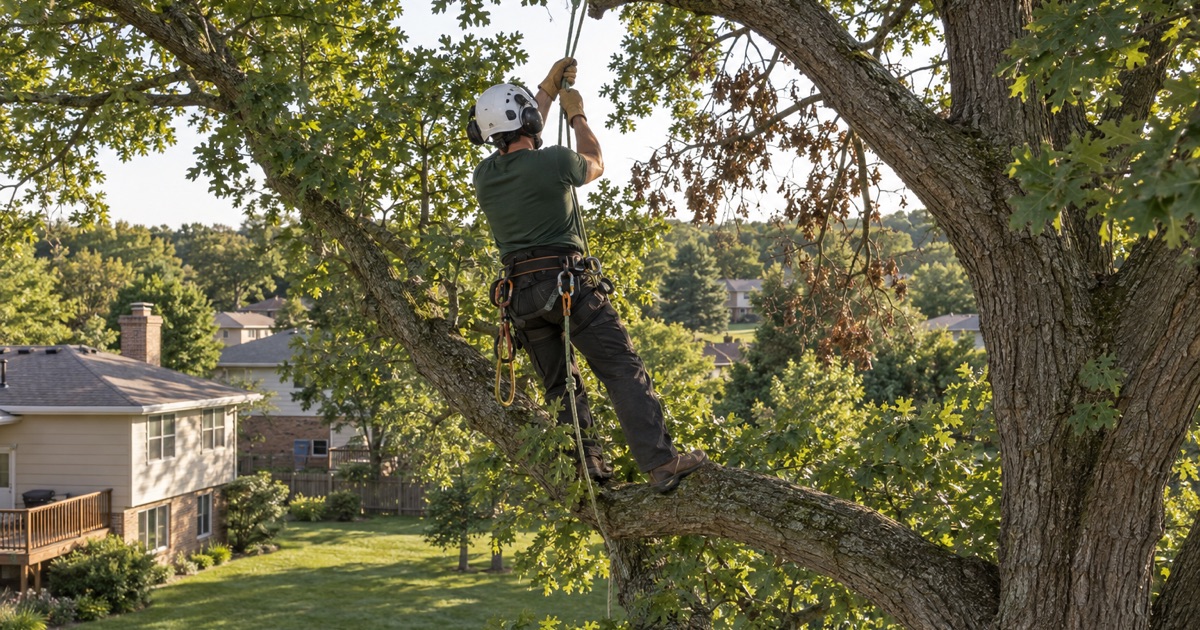
Climber advancing on his climbing line inside the crown of a bur oak on a Lenexa split-level lot.

Structural Pruning While a Tree Can Still Be Shaped

Structural pruning removes competing leaders and establishes one dominant stem while the cuts are still small enough to close over. On a young tree that is an hour with a pole saw; on a forty-year-old one the same correction means taking limbs large enough to leave permanent wounds, which is why the timing on this work matters more than the price of any single visit.

Crown Cleaning, Raising, Reduction and Thinning Explained Plainly

Crown cleaning takes out dead, diseased and broken wood; crown raising lifts the lower limbs for clearance over walk and street; crown reduction shortens the outer edge back to live laterals; and thinning selectively opens the canopy. They are four separate operations under ANSI A300, they price differently from one another, and the instruction to trim the tree names none of them.

Why Topping Is Malpractice and What to Ask For Instead

Topping cuts a crown back to stubs, and the tree answers with weakly attached regrowth standing on decaying wood - a worse hazard than the one it was meant to solve, arriving within a few seasons. Ask for crown reduction back to live laterals instead. It costs more on the day and it does not have to be bought again every three years.

Emerald Ash Borer: The Treat-or-Remove Decision, Priced Both Ways

The decision is arithmetic rather than sentiment: a healthy, well-placed ash treated on a cycle, set against the cost of removing that same tree later when the wood is brittle and the crane bill is larger. The Johnson County extension service already lists green ash among the trees it does not recommend planting here. We price both paths and write down the assumptions behind each.

Oak Wilt in Eastern Kansas and Root Graft Trenching

Oak wilt travels between neighboring oaks through grafted roots as well as by beetle, which is why removing an infected tree on its own can still leave the oak beside it infected through the ground. Root graft trenching severs that path before the tree comes out, and oaks are kept out of the high-risk spring pruning window for the same reason.

Cabling and Bracing a Codominant Stem

When two stems of near-equal size compete instead of one dominating, the union between them carries the entire load of both. A cable set high in the crown reduces the movement at that union and brace rods take the shear across it - hardware that buys a good tree decades, provided it is inspected on a cycle rather than fitted once and forgotten about.

Included Bark, and Why It Doubles the Hardware a Tree Needs

Where two stems press against each other as they grow, bark gets trapped in the union instead of wood, so the joint is a seam rather than a weld. Included bark is what turns an ordinary codominant stem into a failure waiting on a wind event, and finding it is what moves a tree from a single cable to a cable-and-brace-rod system.

Root Collar Excavation and Air Spading a Buried Flare

A trunk that enters the ground like a telephone pole, with no visible flare, is usually buried - by fill, by grade work, or by years of mulch piled against it. An air spade strips that soil off without cutting roots so the collar can be inspected for girdling roots and decay, and it is the first thing to check on a tree declining for no obvious reason.

Soil Decompaction and Radial Trenching for a Stressed Tree

About 21 percent of Lenexa’s housing was built in 2010 or later, which means the working medium on those lots is engineered fill and compacted subgrade rather than the mapped soil, and roots do not function in it. Radial trenching and decompaction inside the critical root zone put air and water back into the profile - treatment for a tree that is stressed rather than sick.

Lightning Protection for a High-Value Shade Tree

A specimen tree shading half a yard is usually worth more than the system that protects it. A lightning protection conductor run from the upper crown down to a ground rod set outside the critical root zone gives a strike a path that is not the trunk, which is worth doing on the one irreplaceable tree on a property rather than on every tree standing in the yard.

Stumps, Debris and Land Clearing

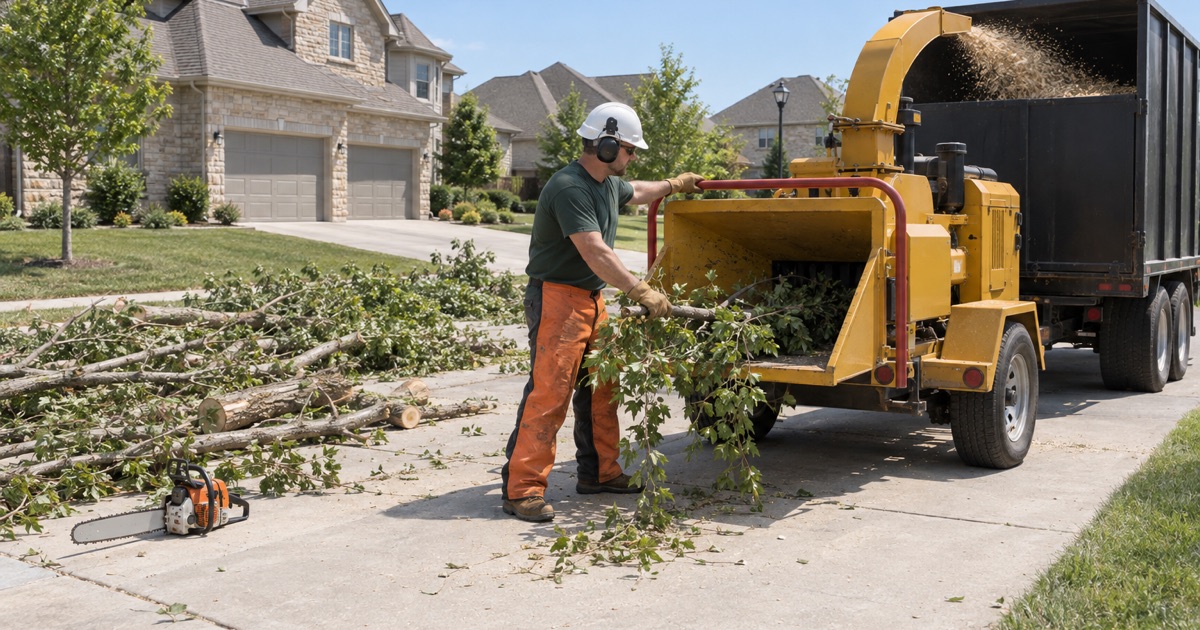
Worker feeding hackberry limbs into a chipper from the side of the infeed at a Lenexa driveway mouth.

Grind the Stump or Remove It: The Honest Comparison

Grinding turns the stump into chips in place and leaves the root plate to decay; full removal takes the root mass out and leaves a hole and a machine track across the lawn. Grinding wins here on cost and on disposal both, because Missouri Organic Recycling refuses stumps with dirt and the county landfill caps landscape waste at three inches in diameter.

Grinding Depth, and What Is Actually Left in the Ground

A stump grinder cutting wheel works roughly twelve to twenty-five inches below grade, and on the deep loess-derived soils around here the machine’s own reach binds long before rock does. The shallow residual series in eastern Kansas are the exception - Vinland runs only about ten to twenty inches to bedrock - so nobody should promise a below-grade depth sight unseen.

Where the Wood, the Logs and the Chips Go When We Leave

Chips go to a site that wants them or leave on the truck, logs go to a yard that takes them by the load, and brush goes to a gate that will accept it. Missouri Organic Recycling takes brush at ten dollars per cubic yard and logs up to forty inches in diameter if they are under five feet long, and that cost sits inside the estimate rather than arriving afterward.

Lenexa’s Brush Rules: Forty-Eight Inches, Eighteen Inches, Sixty-Five Pounds

The published rule is exact: limbs and brush securely bundled no longer than forty-eight inches, no more than eighteen inches in diameter and weighing no more than sixty-five pounds each, or loose in rigid containers no larger than thirty-five gallons, with six bags or bundles per pickup and ten during October and November. There is no per-branch diameter cap and no contractor exclusion - there is simply no capacity for a removal.

Private Subscription Hauling, and Why Your Pile Is Not the City’s Problem

Collection here is private subscription and the city’s own instruction is to contact your hauler for what is accepted, so the disposal terms binding a Lenexa homeowner sit in a contract rather than in a public rule anyone can look up. The monthly December-through-February cadence then lands on exactly the season when storm limbs are most likely to be lying in the yard.

Burning Brush in April Is Prohibited in Johnson and Wyandotte Counties

Kansas air regulation K.A.R. 28-19-645a prohibits open burning of waste - vegetation and wood waste included - during April in Johnson and Wyandotte counties, and does not name Leavenworth. Burning brush from nonagricultural land clearing needs approval from the local authority year-round regardless. April is also when clearing work gets scheduled, so we plan the pile out by truck instead of around a burn.

Yard-Waste Gates Price by Cubic Yard, by Vehicle and by Branch Diameter

Every gate prices differently and most carry a size rule. Missouri Organic takes brush by the cubic yard and lawn debris cheaper than that; the Johnson County landfill will not accept landscape waste over three inches in diameter; and the Olathe compost site is posted for Olathe residents only. Choosing the gate before the saws start is what keeps disposal from quietly doubling.

Lot Clearing for a Build, an Addition or a Fence Line

On a development site the rules invert. Lenexa’s code asks for a tree survey locating and identifying by common name every tree greater than ten inch caliper, credits trees of two to ten inch caliper one-for-one and larger ones two-for-one, and requires protective fencing set no closer to a saved tree than its drip line. Clearing to a plan costs less than clearing and then explaining.

Shrub, Hedge and Overgrown Fence Line Removal

An overgrown fence line is a removal job with a fence inside it, and the fence is what makes it expensive. We take out hedges, volunteer growth and root balls in a way that leaves the line workable for whoever rebuilds the fence, rather than cutting everything to grade and leaving a row of stumps hard against the posts.

Firewood, Log Value, and the One Disease That Ends That Conversation

Sound hardwood has value and we will tell you when a removal has produced some. Pine wilt does not: K-State Research and Extension publication L722 directs that an infected pine be cut down as soon as possible, cut to the ground with no stump left, and the wood chipped or burned immediately - and states outright not to save that wood for firewood.

Areas We Serve

Lenexa Tree Removal provides tree-removal throughout the greater Lenexa area, with the same crews and the same standards on every job.

Good to know

Frequently Asked Questions

How do you price a tree removal?

Every removal is quoted against what the tree is actually doing rather than by the hour: its size and species, its lean and defects, what sits inside the drop zone, and whether the wood can be felled or has to be rigged out piece by piece. The estimate is written before any work is scheduled, and it names the individual tree, the method and exactly what is being taken away.

What does cleanup include on your estimates?

Whatever the estimate says it includes, in words. The debris leaves with us and the site is left rakeable on a standard removal, which means the brush, the chips and the wood, and the estimate says so rather than leaving you to find out on the day that haul-away meant the small stuff. Where you want the rounds kept for firewood or the chips left on site, that is written in too.

Do I need a permit to remove a tree in Lenexa?

Not on a finished, occupied lot. Lenexa's tree provisions sit in the Unified Development Code at Section 4-1-D-2, and its applicability clause reaches new development, expansions and modifications rather than a standing house. The city also tells homeowners that a right-of-way tree on their property is theirs, and that no replacement is required if it comes out. Neighboring cities answer both questions differently, so we confirm per address.

Is a tree service required to be licensed in Kansas?

The state licenses nobody to cut trees, and Johnson County's eleven contractor classes all cover the construction, alteration, repair or demolition of structures, so no company working in Lenexa can honestly call itself a licensed tree service. Ask for the certificate of insurance instead and ask whether a certified arborist is on staff. That is the city's own advice on its homeowner tree page.

How quickly can you respond to an emergency?

Same day when a tree is on a house, a car, a drive or a power service, including after hours and weekends. If a conductor is down, arcing or bridged by a limb, nobody works the site until the utility has cleared it - Evergy's published instruction is to call 911 first and then Evergy at 888-544-4852. We work the structure and the access route while that is happening.

Do you haul the wood and brush away?

Yes, on every removal unless you ask us to leave it. Lenexa's curbside yard-waste rule takes bundles no longer than forty-eight inches, no more than eighteen inches in diameter and under sixty-five pounds, six per pickup, which is nowhere near one tree. Leaving a removal at the curb turns a finished job into a pile nobody will collect.

Is stump grinding part of the removal or a separate charge?

It is a separate line, priced separately, and it is always quoted so you can decide. A grinder wheel works roughly twelve to twenty-five inches below grade, so what is left is a decaying root plate rather than bare soil. On the newer parts of Lenexa the working medium is engineered fill rather than mapped soil, and no honest quote promises a below-grade depth sight unseen.

Can my tree be saved instead of removed?

Often, and we say so when it can. A split or codominant stem can be cabled and braced, an overextended crown reduced back to live laterals, a buried root flare excavated with an air spade, and compacted ground opened up inside the critical root zone. Where a treatment is realistic we price it beside the removal and let the two numbers argue rather than quoting the removal alone.

How long does a removal take from the estimate to a clear yard?

A single residential tree is usually one day on site once it is scheduled, with the stump ground on the same visit or the next one. What moves the date is access and crane availability rather than the cutting: a tree needing a crane pick on a street that has to be coned is booked around the equipment, and spring storm weeks push routine work back. We give you a date and tell you what would change it.

My neighbor's tree hangs over my yard - what can I do about it?

In Kansas you may trim what overhangs your property line and you may not enter your neighbor's land to do it, and under Pierce v. Casady a tree doing substantial harm or creating imminent danger can be a nuisance your neighbor may be compelled to abate. Across the state line Missouri answers the opposite way. We settle which rule applies before quoting, not at the fence.

Ready to Get Started?

Request a free quote today and we'll get back to you fast.