
Lenexa Tree Removal offers tree planting service and transplanting in Lenexa, KS, and it is the same crew that takes trees down. That turns out to matter, because twenty years of removals is a long record of which species failed here, at what age, and on which kind of lot - which is exactly the knowledge a planting decision needs.
Most failed plantings in this city fail for one of three reasons: the species was wrong for the ground, the flare was buried, or the tree went into compacted fill nobody loosened. None of those show up in the first two seasons, which is why a cheap planting looks fine right up until it does not.
So we plant from the site outward. What the soil actually is on that lot, what the code requires, what the extension service refuses, and what the tree is supposed to be doing in thirty years - then the species, and only then the hole.
Choosing a Species That Is Still Here in Thirty Years
What the Extension Service Refuses
The Johnson County K-State Research and Extension Master Gardeners brochure for metropolitan Kansas City is unusually direct, and it is the local document worth starting from. Its not-recommended column includes silver maple for weak wood, pin oak for soil issues, green ash for emerald ash borer, and Bradford pear, Austrian pine, Scotch pine, box elder, Siberian elm, Lombardy poplar and willow among others.
Where the City and the Extension Service Disagree
Lenexa publishes its own recommended street tree species - bald cypress, elm, ginkgo, red and white oak varieties, sugar maple and tulip tree - while the extension brochure puts red maple and white ash in a plant-with-caution column and refuses several relatives outright. That gap is not a contradiction to smooth over; it is a real judgement call about site, and it is where most of the useful conversation about a planting happens.
The Trees With a Clock on Them
Some species are being written out of the market rather than out of fashion. The Kansas Department of Agriculture is bringing in a permanent statewide Callery pear quarantine effective January 1, 2027 prohibiting sale and movement of all seeds, plants or parts, and across the state line Missouri’s own sale ban on Callery pear takes effect January 1, 2029 under legislation signed in July 2025. Planting one now buys a future problem.
Planting Depth, Flare and the Ground You Actually Have
Find the Flare Before Digging the Hole
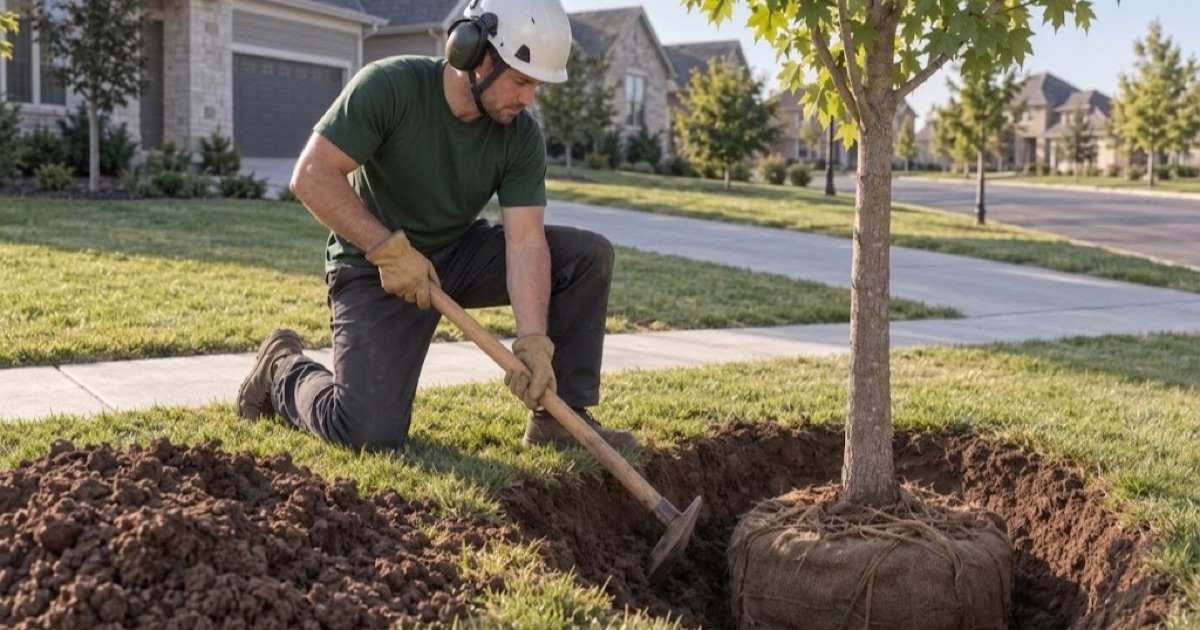
The root flare - the point where the trunk widens into the structural roots - belongs at finished grade and visible. Nursery stock routinely arrives with the flare already buried inside the ball or container, sometimes by several inches, so the first task is to excavate down to it and set the hole depth from the flare rather than from the top of the ball as delivered.
Fill, Subgrade and the Newer Half of Lenexa
About 21 percent of the city’s housing was built in 2010 or later, and roughly seventy-two percent of the whole stock predates 2010, so this is a city with a large young-lot cohort where the growing medium is engineered fill rather than the mapped soil. A soil survey does not describe engineered ground, and a tree planted into an unloosened pocket of it grows a root system the shape of the hole.
Wide and Shallow, Not Deep and Amended
The planting excavation should be considerably wider than the root ball and no deeper than it, with the sides broken up rather than glazed smooth by a bucket. On compacted lots we loosen a broad area around the hole rather than backfilling with imported topsoil, because a rich pocket in tight ground encourages roots to circle inside it rather than leave.
What Lenexa’s Code Expects on a New Lot
Two Deciduous Trees per Single-Family or Duplex Lot
The code is specific: in addition to required street trees, two deciduous trees are required for each single-family or duplex lot, at least one of them a shade tree and at least one located in the front yard. Existing trees can be credited toward that requirement provided they are of code-compliant size, type and location, which is another reason the keep-or-clear decision is worth making carefully.
Street Trees Are the City’s to Plant
In single-family and duplex subdivisions with average lot sizes under one acre, the City provides and plants the street trees itself, at an intended one tree for every forty linear feet of street frontage, and the Parks and Recreation Director determines the botanical name with input from the property owner. Those trees carry a one-year warranty, within which the City replaces a failed tree once at no cost to the adjacent owner.
The Easement Behind the Curb
Owners in single-family and duplex projects requiring street trees grant the City a fifteen-foot-deep landscape easement along the right-of-way lines. Knowing where that strip runs matters for your own planting, because a tree you put in near the curb is sharing space with a program you do not control and with the right-of-way the city says is roughly eleven to fifteen feet back from the curb.
Transplanting an Established Tree
Root Ball Against the Critical Root Zone
A transplant takes a root ball that is only a fraction of the critical root zone the tree actually grew, and everything else about the job follows from that ratio. Survival falls steeply as trunk diameter rises, so we size the ball against the caliper honestly and tell you the odds rather than quoting a move that was always going to fail.
Root Prune a Season Ahead Where It Counts
On a tree worth real money, cutting a clean trench at the future ball line a full growing season before the move lets the tree build fine roots inside that line. It turns a shock into a planned interruption, and it is the single intervention that most changes the outcome on a mid-size transplant.
Aftercare Is Most of the Cost
A moved tree is a tree with a fraction of its roots and all of its crown, so the first two seasons are about water and about not asking it to do anything else. Mulch to the drip line and away from the trunk, no fertilizer pushing top growth it cannot supply, and no pruning beyond broken wood until it has established.
- Insured, Proof Provided
- 20+ Years in Johnson County
- Free Written Estimates