
Lenexa Tree Removal handles shrub and hedge removal in Lenexa, KS, along with the brush and volunteer growth that comes with it. Twenty years of removals here means most of this work arrives as the second half of a larger job - a fence going in, a lot being cleared, or a screen that stopped screening a decade ago.
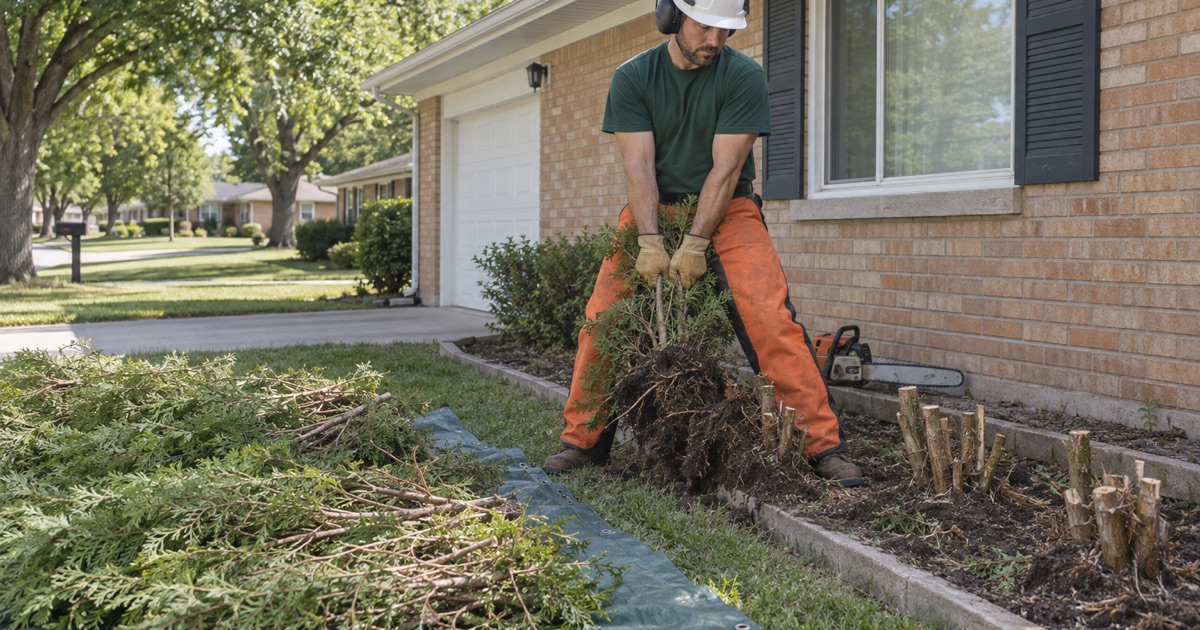
The difference between a good shrub removal and a cheap one shows up a season later. Cut to grade, a hedge line resprouts everywhere and leaves a strip that cannot be dug, planted or posted through; taken out with the root balls, the same strip is ready for whatever comes next.
The other half of the job is disposal, and it is the part homeowners consistently underestimate. Curbside collection here takes six bundles a week at forty-eight inches and sixty-five pounds each, which is not remotely a hedge run - so the material has to leave with a truck, and where it goes belongs in the estimate.
Overgrown Hedges, Screens and Foundation Plantings
The Hedge That Outgrew Its Job
A hedge planted as a four-foot boundary and left for fifteen years is not a hedge any more; it is a row of small trees with the lower two-thirds shaded out and bare. At that point cutting it back does not restore it, because there is no live foliage low down to regrow from. Removal and replanting is usually cheaper than three years of trying to bring it back.
Failing Conifer Screens
Pine is the screen conifer that fails around here, and it fails visibly. K-State Research and Extension records that Scots pine plantings in eastern Kansas have been devastated and that Austrian pines have been affected in recent years, and the county extension brochure lists both among the trees it does not recommend at all.
With pine wilt the removal carries a published deadline and a sanitation rule: down as soon as possible, by May 1 at the latest with April 1 the better target, cut to the ground with no stump left, and the wood chipped or burned immediately rather than kept for firewood.
Foundation Plantings Against the House
Shrubs planted tight to a foundation grow into the siding, block the gutters, hold moisture against the wall and eventually lift the walk. Taking them out is straightforward; taking them out without damaging what they have grown into is the skilled part, and it usually means cutting the top out in sections before anything touches the root ball.
Fence Lines, Boundaries and Volunteer Growth
The Overgrown Fence Line
An overgrown fence line is a removal job with a fence inside it, and the fence is what makes it slow. Volunteer growth wraps the posts, roots lift the bottom rail, and half the material cannot be pulled without taking the fence with it. We work the line back to something a fence contractor can actually rebuild on.
Where the Property Line Stops the Saw
Under the Kansas rule from Pierce v. Casady you may cut what overhangs your side of the boundary, and you may not step onto your neighbor’s land to do it. That limit decides whether a hedge line can be worked from one side with a lift on your own driveway or needs an agreement next door, and it is far cheaper to settle before the crew arrives.
Volunteers You Should Not Let Seed
Some of what comes out of a neglected line should not be allowed back. Callery pear seedlings are the clearest case: the Kansas Department of Agriculture is bringing in a permanent statewide quarantine effective January 1, 2027 prohibiting sale and movement of all seeds, plants or parts, and the county extension brochure already tells homeowners not to plant the Bradford cultivar because of severe splitting on ten to fifteen year old trees.
Roots, Stumps and What Is Left Behind
Pulling Root Balls Against Grinding Them
Shrub root balls are usually small enough to pull, which is faster and leaves cleaner ground than grinding. Hedge stumps of any size, and anything against hardscape or a fence post, are ground instead - partly for control and partly because Missouri Organic Recycling, the nearest large gate, refuses stumps with dirt outright, so a pulled root ball has fewer places to go.
Utilities and Irrigation Under a Hedge Line
Hedge lines are where irrigation mains, low-voltage lighting and invisible fence wire tend to run, because that is where somebody hid them. Kansas 811 goes in before any grinding or excavation at 811 or 1-800-DIG-SAFE, and the private lines past the meter - which the public locate does not cover - get asked about and hand-marked separately.
Leaving the Strip Usable
What you want at the end is a strip you can do something with. We backfill where root balls came out, clear the debris rather than tucking it under the fence, and leave the line raked and ready for turf, a new planting or a fence crew - which is the point of removing the hedge in the first place.
Commercial Screening and Required Landscaping
Buffers That Are Not Simply Yours to Remove
On a developed commercial site the screen along a property line may be required landscaping. Lenexa’s code states that landscaping, buffering and site design features required by the section shall be continuously maintained according to its standards, so removing a buffer without a replacement plan can turn a maintenance job into a compliance problem.
Dumpster Enclosures, Parking Islands and Frontage
The screening that actually gets neglected is the small stuff: shrubs around a trash enclosure, planting in parking islands, and the frontage strip that everybody drives past. That work is scheduled around operating hours, kept out of drive lanes, and finished with the surface swept rather than left with spill in a truck route.
Multifamily and HOA Common Areas
Nearly forty-four percent of Lenexa’s housing is attached or multifamily, so a great deal of shrub and hedge work here is ordered by a board or a management company against a common-area budget. Those jobs get a written scope by area and a schedule, so the work can be approved, filed and compared against next year rather than agreed on site.
- Insured, Proof Provided
- 20+ Years in Johnson County
- Free Written Estimates