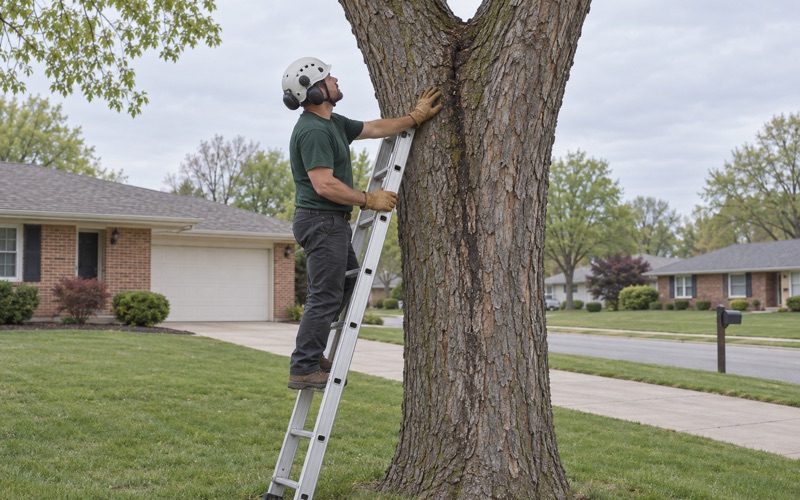
Lenexa Tree Removal has been handling tree removal in Prairie Village for more than twenty years, and on a lot here the first question we answer is not how big the tree is. It is what else is happening on the property. The city’s tree protection rules sit inside its landscape standards and do nothing at all until one of three specific situations is present, which is how two neighbors with matching trees end up in completely different positions.
That answer decides the shape of the job: either the removal is ordinary work we schedule around the weather and the wire, or it is a regulated act that has to go through the city before a saw comes off the truck. We tell homeowners which of the two they are in while the estimate is still being written, and that estimate names the tree, the method and exactly what cleanup is included.
Twenty years in Johnson County and across the state line into Missouri has mostly taught us that these rules change at the city limit, and that the version a contractor picked up one suburb over is often the wrong one here. We hand over proof of insurance for tree work before the first cut, and we quote against what the tree is actually doing rather than by the hour.
Three triggers, and only one of them reaches a finished lot
Ordinance 2446 was passed by the Governing Body on March 15, 2021 and took effect on June 1, 2021, adding a tree protection section to Chapter 19.47, the city’s landscape standards. The applicability subsection, Section 19.47.060(a), is the part that decides whether any of it reaches you, and it lists exactly three triggers. Everything downstream of it is inert unless one of the three is present, which is why an ordinance that reads as strict on paper leaves most finished, occupied lots alone.
The right-of-way leg has no size floor
The first trigger is any removal of a tree in the public right-of-way, other than one authorized by an official City project. No construction is attached to it and no size floor sits under it: the tree is regulated because of where it stands, and its removal runs through the city rather than through the property owner. This is the single leg of the rule that binds a lot where nothing at all is being built, and the one homeowners are most often surprised by. The city’s own Tree Board packet makes the same point from the other direction: “Back yard tree removal permits not required, only the right of way trees.”
Where the right-of-way line actually falls is a matter of record rather than a matter of eyesight, so on anything near the curb we establish it before we quote a method. A tree in the curb strip and a tree standing in the front yard can sit under different halves of this ordinance, and the boundary between them is not visible from the street.
The second trigger, and a numbering problem in the adopted text
The second trigger covers all applications already subject to the landscape standards, a route a site plan or a landscape submittal arrives on rather than something a single homeowner runs into. How that leg is drafted is worth flagging, because the applicability text points at “the landscape standards in Section 19.47.010 (B)” while Section 19.47.010’s own subsections carry no (A) or (B) at all, running instead as a statement of intent followed by an applicability clause. We report the inconsistency and leave resolving it to the city rather than to a tree crew, since the trigger it belongs to is the one that decides whether a project is regulated in the first place.
Looking for tree-removal closer to Roeland Park? See Tree-Removal in Roeland Park.
The 600-square-foot line and the 10 percent line
The third trigger is the one that catches homeowners, and it operates in R-1A and R-1B zoning only. Inside those two districts it names four situations: a new residential structure built on a vacant lot; an existing residential structure torn down, whether that is a demolition on its own or a demolition and rebuild; a remodel that adds more than 600 square feet to the existing building footprint; and a remodel that tears down more than 10 percent of the existing structure associated with the new construction. Meet one of them and the tree protection section applies to the property, whether or not the trees are anywhere near the work.
Footprint is not floor area
The 600-square-foot line is drawn against the existing building footprint, which is not the same measure as finished floor area. A second story can add a great deal of living space without touching the footprint, while a modest ground-floor family room puts most of its area straight onto it. That is why the honest moment to ask this question is the schematic stage, when the addition’s shape is still moving, rather than the week the permit set comes back.
The 10 percent line is measured on the structure
The fourth situation is different in kind: a remodel tearing down more than 10 percent of the existing structure associated with the new construction. A gut of the back half of a house can clear that line while adding no footprint at all, and the two lines run independently of each other, so either one on its own pulls the tree section in. We ask what the demolition plan shows before we say anything about what happens to the trees.
Why R-1A and R-1B are named and other districts are not
The construction trigger names R-1A and R-1B and no other zoning district, so a property outside those two is not reached by that leg of the rule at all. The first two triggers take no notice of zoning, which means a right-of-way tree stays a right-of-way tree wherever in the city it stands. Zoning is a matter of record with the city and worth confirming rather than assuming from what the block looks like.
Planning an addition on a lot with trees worth keeping
Sequencing matters more here than in most cities, because the way out of the rule is conditioned on design decisions that get harder to reverse the further a project runs. Once the section applies, taking out a protected tree needs written authorization from the Building Official, on a request that identifies the specific tree and documents why it should come out.
The exception route, and the grounds it turns on
Section 19.47.060(e) says the Building Official shall generally grant the exception where the tree is dead, or where it is diseased or dying and constitutes a threat to healthy trees, property or public safety. The third ground is removal necessary for construction, development or redevelopment, under a three-part test: all reasonable efforts made to avoid removal through comparable alternative designs, undue financial burden on the applicant, and no other reasonable accommodation available, including adjustments to the otherwise allowable building footprint or site design. The Building Official may seek advice from the Prairie Village Tree Board, other staff or departments, or a third-party consultant, and the authorization lasts for the duration of the associated permit.
The documentation is most of the work
On the dead-or-dying grounds, what is really being bought is a written finding: somebody has to record what is wrong with the tree and why it threatens something. We assess against the ISA Basic Tree Risk Assessment Form and describe defects in ANSI A300 terms, from codominant stems with included bark to critical root zone damage and decay at the root collar, and where a visual inspection cannot carry the finding on its own a resistograph reading can. We also say plainly when a tree does not need to come out, and we price the crown reduction or the cabling and bracing beside the removal so the choice is a real one.
Enforcement counts every tree separately
Section 19.47.060(f) makes removal, damage or impairment of a protected tree a violation, and says each tree shall be considered a separate incident, with any fines and penalties in addition to the mitigation the section already requires. Note what it does not do: the ordinance itself names no dollar figure, and the general penalty provision sits elsewhere in the code, at Section 19.01.045. Mitigation and penalty are cumulative rather than alternative, which is the part usually missed when someone weighs the risk of simply taking a tree down.
What the plat, the curb and the lines change about the work
Prairie Village was platted in 1941 by J.C. Nichols on a 65-foot street frontage, smaller than usual for his developments, and the housing that followed is dense and detached at 84.37 percent one-unit detached and 1,656 units per square mile. Trees planted with those houses came in as one cohort rather than a scatter, since 45.37 percent of the entire housing stock was built between 1950 and 1959, so structural failures tend to arrive in waves after a hard storm season. Sequencing several removals across months usually beats trying to buy them all in one week.
A 65-foot frontage decides the equipment
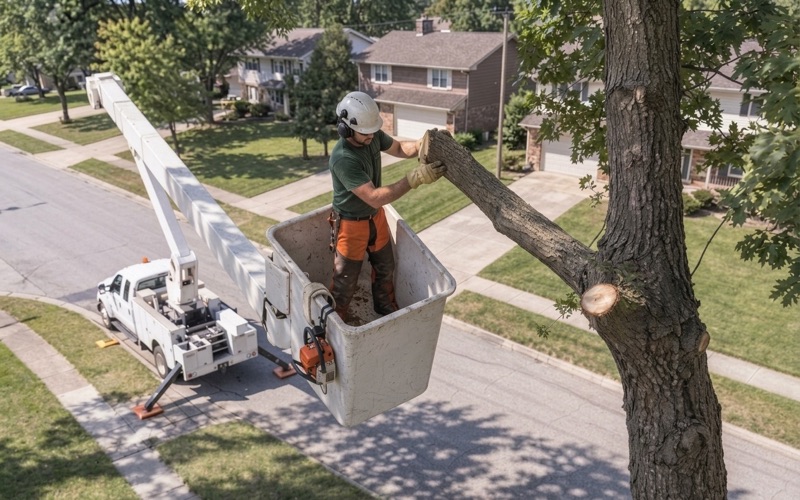
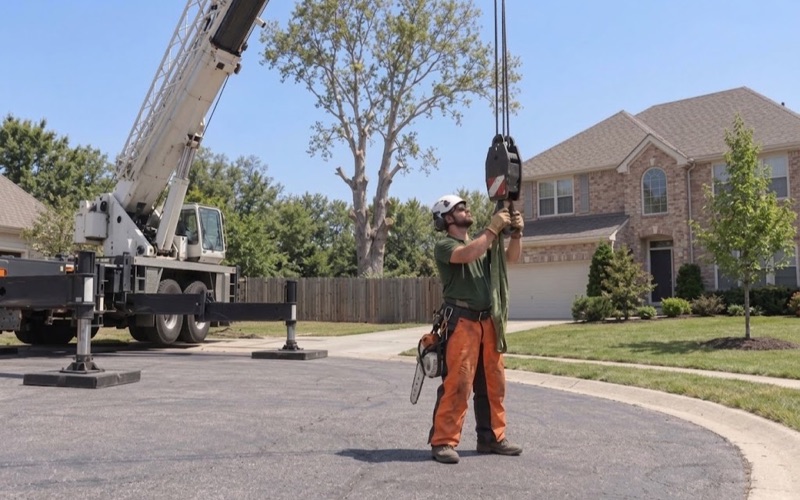
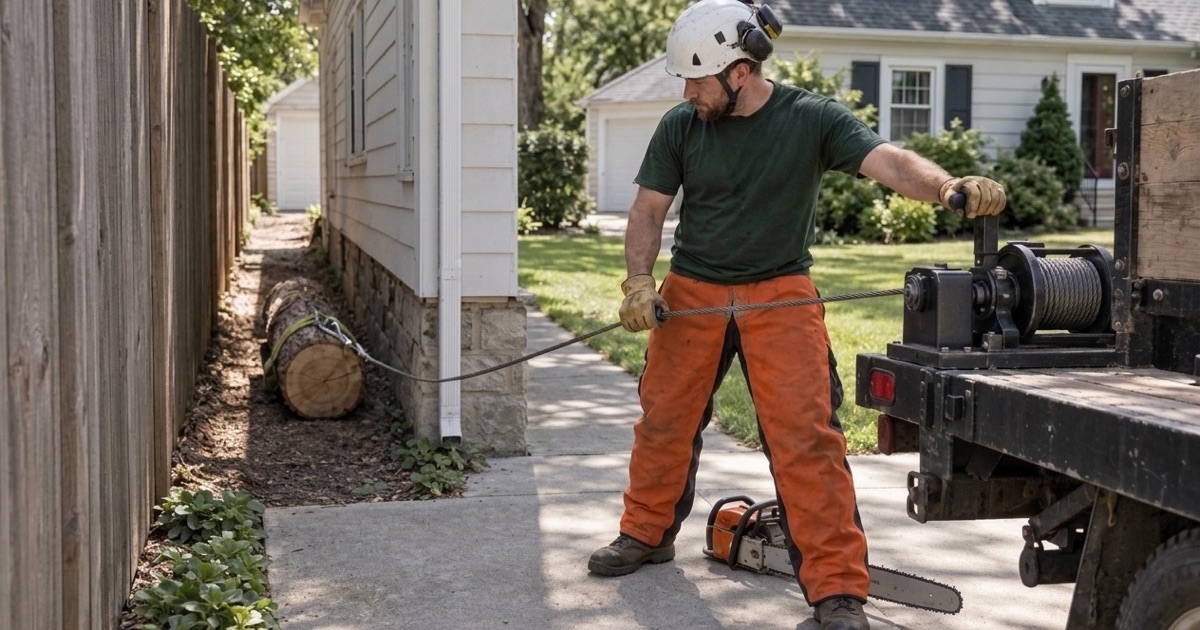
On a narrow lot the gate question and the crane question arrive at the same time. A compact stump grinder will pass a 35-inch gate and a pedestrian-gate class machine will pass 25 inches, but the chipper never goes through a gate at all, so what really prices a back-yard removal is brush handling and how far the wood has to be carried to the truck. Where a bucket truck cannot reach the canopy we bring crane or lift access rather than take the tree apart in more pieces than it needs.
The curb will not take removal wood
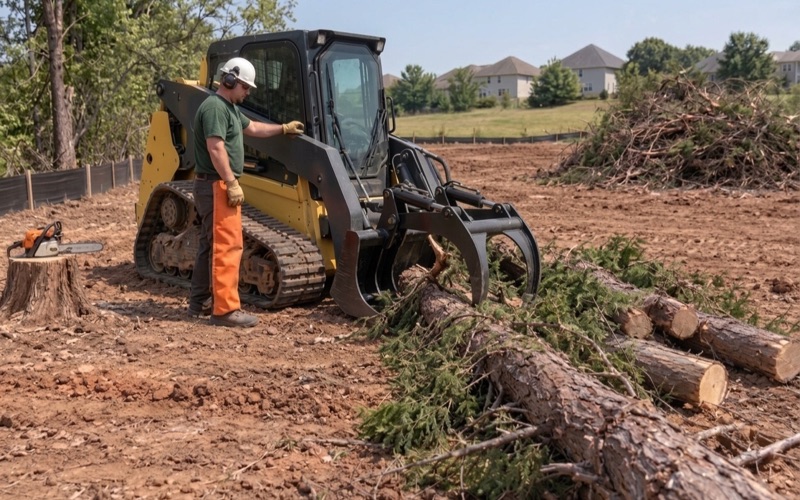
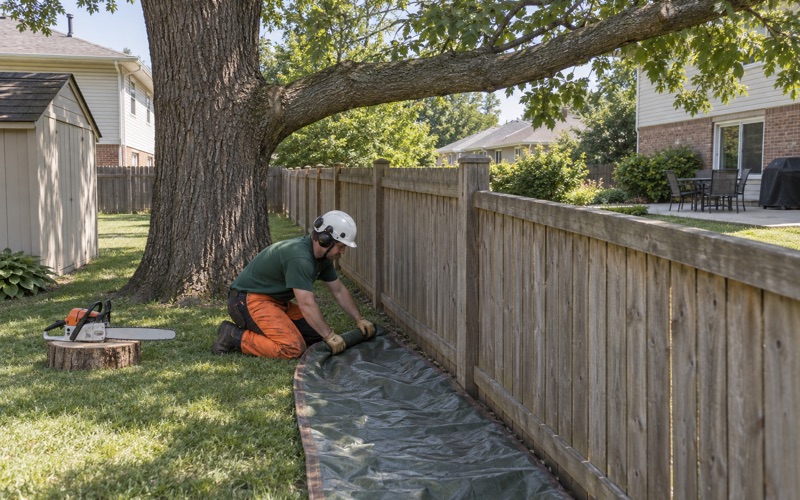
The city’s yard waste rule refuses removal debris in plain terms. Residents are allowed 12 yard waste items per week year round; bundles must be four feet in length, less than 24 inches in circumference and less than 50 pounds, tied together with twine, and individual branches within a bundle cannot be more than 3 inches in diameter. The published rule also states that logs are not accepted, and there is nothing municipal behind it, since Johnson County operates no public yard-waste gate and removal wood crosses the state line to Missouri Organic Recycling in Kansas City, Missouri at $10.00 per cubic yard for brush. That is the arithmetic behind a line in our estimates: the debris leaves with us and the site is left rakeable.
Overhead lines, stumps and what we check first
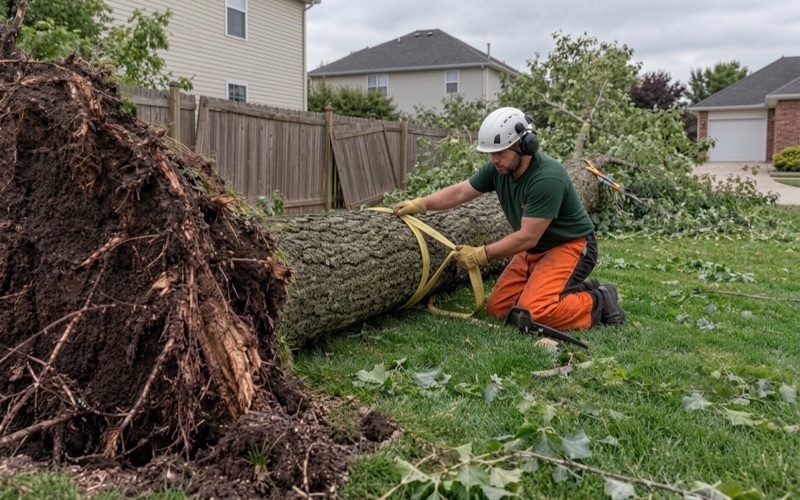
Evergy Kansas Metro serves this side of the state line under the Kansas Corporation Commission, and Kansas adopts the National Electrical Safety Code by reference at K.A.R. 82-12-2 without publishing a vegetation management plan, so the trim cycle here is not a public document. Evergy treats the service drop from the pole to the meter as the customer’s responsibility, and on an assist it removes all limbs within ten feet of energized conductors and leaves any debris at the worksite, so a crew is still wanted for the cleanup and for the rest of the tree. ANSI Z133 keeps our people away from energized conductors in thunderstorms and high wind, and when a tree is on a house, a car, a drive or a power service we respond the same day.
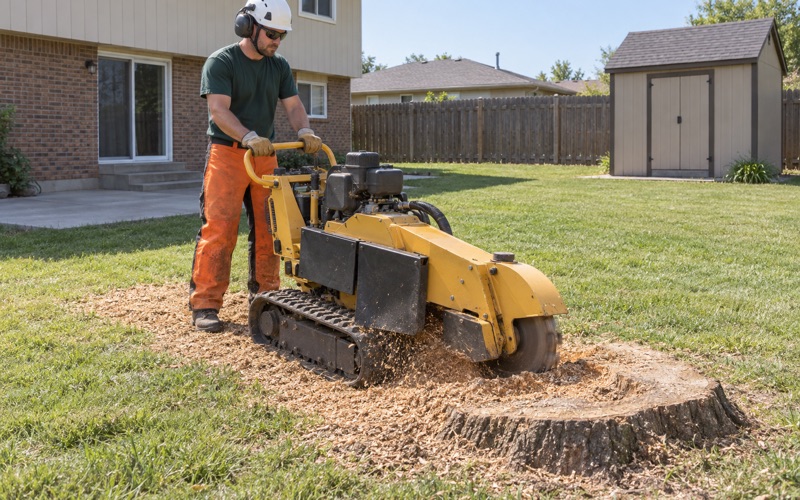
Stump work carries its own local unknown. Depth to a restrictive feature in the series mapped across Johnson County runs 4 to 20 inches on Sogn and 10 to 20 inches on Vinland, against a grinder’s below-grade cut of roughly 12 to 25 inches depending on machine class, so on some parcels rock stops the cutting wheel first. We look before we promise a depth below grade, and we call 811 every time on a 1941 plat where services run close to the curb.
- Insured, Proof Provided
- 20+ Years in Johnson County
- Free Written Estimates