
Lenexa Tree Removal has been dropping, reducing and grinding trees for more than twenty years, and tree removal in Olathe starts with one question we ask before anything is loaded onto a truck: how tall is this tree, and what is above it. Most of the work here is ordinary. A pear that split down the union at fifteen years, a silver maple over a driveway, an ash that emerald ash borer finished three summers ago — all of it quoted against what the tree is actually doing rather than by the hour.
The rest of it is height, and height in this city is not a judgment call. Olathe sits inside the interest areas of two separate county airfields, and in the regulations covering them a tree is not landscaping. It is an object measured in feet above the ground, written into the same clause as a building. That changes who answers before a tall tree comes down, goes up in a lift, or simply keeps growing.
We are insured for tree work and hand the certificate over before a saw comes off the truck. We answer same day when a tree is on a house, a car, a drive or a power service. Every estimate names the tree, the method and exactly what leaves with us. What follows is the part of an Olathe job that is genuinely local.
Two county airfields, one city, and Olathe holds neither
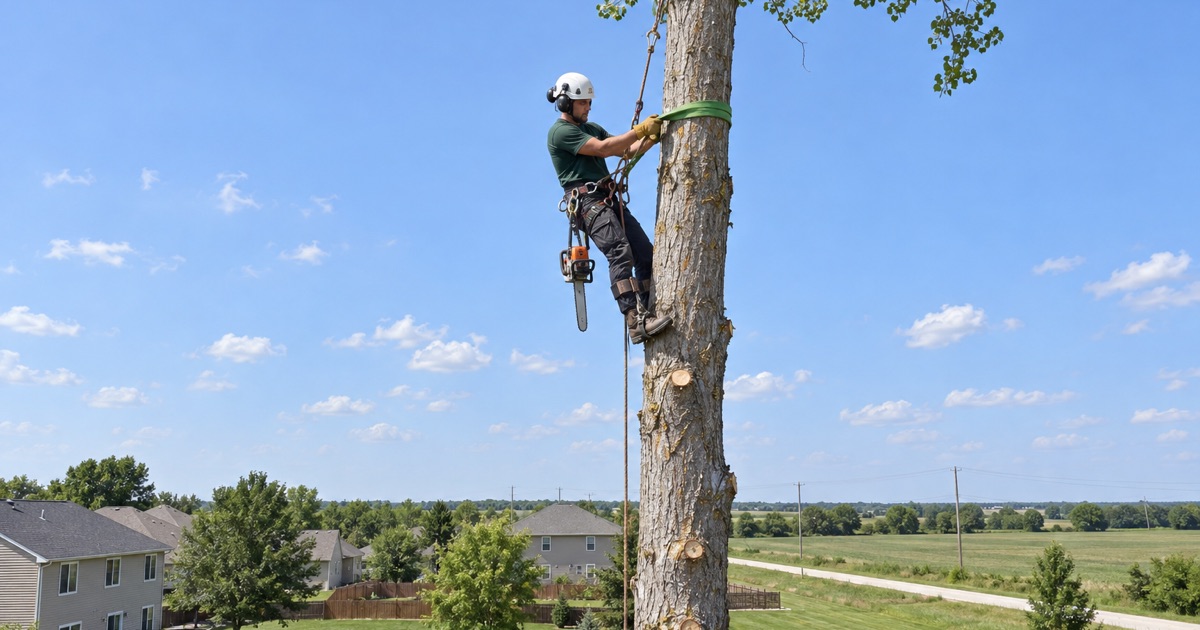
Olathe is the seat of Johnson County and the fourth-most populous city in both the Kansas City metropolitan area and the state of Kansas, with a 2020 population of 141,290. It is also the only city we serve that lies inside the interest areas of two county-run airports at once. Johnson County Executive Airport sits within the city, and its interest area spans Olathe, Overland Park and unincorporated Johnson County. The zoning map for New Century AirCenter spans Olathe, Gardner and Johnson County.
Neither field is the city’s. Johnson County holds zoning and land use authority within a one-mile radius of Johnson County Executive Airport under the Kansas Airport Hazard Zoning Act, K.S.A. 3-301 through 3-322, and has adopted an airport land use compatibility plan whose safety compatibility zones denote physical aircraft-accident risk, with policies covering height limits and flight hazards. Building heights inside the FAA Part 77 imaginary surfaces are constrained, and an airport zoning permit is required for construction in hazard areas.
The city’s height rule and the county’s are two different books
Olathe’s Unified Development Ordinance carries its own height section at 18.30.110, and that one belongs to the city. The airport height surfaces do not. They are county regulations written under a state statute, and they reach across city ground without ever becoming a city rule. A crew that tells you “the city allows” about a tall tree near either field is quoting the wrong authority, and on this subject the wrong authority is the same as no answer.
We will not tell you which surface your lot is under
That is a parcel-level question, settled by where the property sits relative to a runway and by how high the ground itself stands. We have not run that check on your address, we do not run it from a map on a phone in your driveway, and we will not write it into an estimate in either direction. What we do instead is flag the job as one worth a call to the county before the tree gets any taller, and tell you exactly what to ask.
Looking for tree-removal closer to Merriam? See Merriam Tree-Removal.
A tree that is allowed to grow
Most tree rules treat a tree as landscaping — planted, protected, replaced, credited. Johnson County Zoning Regulations Article 21 does something different. It provides that no structure or tree shall be erected, altered, allowed to grow or allowed to exist in any zone in excess of the applicable height limitations. A tree sits in the same clause as a building, and the verb attached to it is allowed to grow.
That phrasing carries the whole difference between a height question and a routine removal. A structure is finished the day it is built. A tree is not. The regulated object changes every season on its own, which means the compliance answer a property owner gets today is asked again later by the same tree at a different height, and nobody sends a reminder.
The seventy-five-foot line
Article 21 does not treat every tree as a hazard. Section 9(C) exempts the growth of any tree to a height up to seventy-five feet above the surface of the land, and Section 9(D)(1)(c) requires no permit for a tree under seventy-five feet in the horizontal and conical zones. Note what is being measured: height above ground, not diameter at breast height, which is the number every other part of this trade runs on.
Nearly nothing we remove in Olathe approaches that line. Yard trees with codominant stems and included bark come down at forty or fifty feet, and the K-State Research and Extension brochure for this county names most of them on sight — silver maple for weak wood, Bradford pear for the splitting that shows up on ten to fifteen year old trees, green ash for borer, along with box elder, Siberian elm, Lombardy poplar and willow. An old bur oak, sycamore or cottonwood on open ground is the different conversation.
The exception that undoes the line
The seventy-five-foot allowance in the horizontal and conical zones carries a carve-out, and it is the part people miss: it does not hold where terrain, land contour or topographic features would carry the tree above the limits. The ground counts, not only the tree, which turns a tape measure on a trunk into the wrong instrument for the question being asked. Johnson County Executive Airport has a field elevation of 1,096 feet and New Century AirCenter 1,087 feet, so a tree standing on ground well above either field begins its seventy-five feet from higher up. On a rise, a tree shorter than the exemption can still be the tall object, and none of that is visible from the driveway.
Markers and lights, at the Airport Commission’s expense
Where a permit is required, Article 21 allows it to be conditioned in a way worth knowing about before anyone panics: the permit may let the Johnson County Airport Commission, at its own expense, install markers and lights on the tree. That single provision tells you the outcome is not automatically a chainsaw. A tree can be a marked object rather than a removed one, and the cost of the marking is not the property owner’s.
Removal is one answer, not the only one
We say so when a tree can be kept, and we price both paths on the same sheet. A crown reduction done to ANSI A300 shortens leaders back to living lateral branches capable of assuming the terminal role, and it has honest limits — a cut that would leave stubs is topping, not reduction, and topping a tree to fit a height number buys three years and a weaker tree. Where the height is genuinely marginal, a reduction cycle started early is cheaper and better than one emergency removal later.
Doing nothing is also a decision
K.S.A. 3-702 declares an airport hazard a public nuisance, which is a heavier word than most homeowners expect to meet in a conversation about a tree. Leaving a tall tree alone near a field is not the neutral option it looks like, because the tree keeps working on the problem while nobody is watching. Trees are the one asset that gets larger when ignored, and the question has a named authority to ask rather than an opinion to take.
Who to ask before the crane goes up
A crane or spider lift setting up on a tight lot is itself a temporary object with a height, and that is worth a sentence at the estimate rather than a discovery on the morning of the job. We plan Olathe picks the way we plan them anywhere — outrigger pads, a rigging block sized to the piece, drop zones walked before the first cut — with the added step of raising the question early where a job sits near either field.
Before the boom goes up
Evergy Kansas Metro answers to the Kansas Corporation Commission, and Kansas adopts the National Electrical Safety Code by reference at K.A.R. 82-12-2. Evergy publishes ten feet of clearance at 600 to 50,000 volts and treats the span from pole to meter as the customer’s responsibility; on an assist it removes limbs within ten feet of energized conductors and leaves the debris at the worksite, which is why a utility visit is usually the start of a cleanup rather than the end of one. ANSI Z133 keeps us away from energized conductors in thunderstorms, high wind, snow and ice, so a storm call gets triaged by phone before anyone is sent up.
A limb blocking a public street or a sight triangle is the city’s to hear about, and Olathe’s municipal code already puts an affirmative duty on the adjacent owner to trim growth that overhangs a public way and to take down a dead tree likely to fall across one. The practical reading is worth stating plainly: in this city the enforcement risk runs toward the tree left standing, not the tree taken down.
Before the grinder goes down
Every stump gets a Kansas One Call ticket at 811, no exceptions and no faster version. On depth we make no promise sight unseen. This is Osage Cuestas country, alternating limestone and shale benches, and the series mapped across Johnson County run from Vinland at ten to twenty inches to a paralithic contact and Sogn at four to twenty inches to bedrock through to Sharpsburg with no bedrock restriction stated at all. Which one is under a given lot decides whether rock or the machine’s own stop ends the cut, and angular chert wears teeth the whole way down regardless.
About sixty percent of Olathe’s housing went up between 1980 and 2009, which means a great deal of what we take out here is first-cycle work — trees planted with the house, now twenty to forty-five years old and arriving at their first real decision. Our crews are local, the debris leaves with us, and the site is left rakeable rather than swept into a pile for somebody else.
- Insured, Proof Provided
- 20+ Years in Johnson County
- Free Written Estimates









