Lenexa Tree Removal has been handling tree removal in Kansas City, Kansas for more than twenty years, and the trees we take down here almost never fail the way the regional advertising says they will. The storm that drops a silver maple across a driveway in Wyandotte County is rarely the one on the billboard, and planning against the wrong failure is how a homeowner ends up paying for the same tree twice. What actually breaks trees on this ground is straight-line convective wind and winter ice, and those two load a canopy in opposite directions.
That distinction is why we quote every removal against what the tree is actually doing rather than by the hour. A trunk leaning on sound wood is a different job from an intact-looking crown carrying two codominant stems and a seam of included bark down the union, and only one of those comes apart in a hard gust. Our written estimate names the tree, the method and exactly what the cleanup covers, and proof of coverage is handed over before a saw comes off the truck.
When a tree is already on a house, a car, a drive or a power service, we respond the same day with local crews on local roads rather than a franchise call center in another state. We work both sides of State Line Road and we know the answers change when you cross it.
What actually brings a tree down in Wyandotte County
The tornado is the event every regional advertisement leans on, and the climatology does not carry it here. The Wichita forecast office’s Kansas tornado record puts the statewide average at 81 tornadoes a year for 1994 through 2023, which is a figure for the whole of Kansas rather than for any address in it. Its county breakdown for 1950 through 2023 runs from Ford County at 113 down to Wyandotte County at eleven, the lowest total of any county in the state.
Those are two different windows measuring two different things, and they are not interchangeable. Eleven touchdowns across the years since 1950 is not zero, and we do not tell anyone it is. It is a poor basis for deciding which tree in a yard is the dangerous one, because the calls we are actually dispatched to arrive along a line of July thunderstorms or under a glaze of February ice.
Why the distinction changes what we recommend
Storm-proofing sold against a tornado is sold against an event no pruning survives, and a tree that will take one does not exist. Wind in the 60 to 90 mph range and a quarter inch of ice are a different proposition: a sound, well-structured tree survives both, and what decides the outcome is the length of a lateral limb, the amount of dead wood left in the canopy and whether a weak union was ever cabled. Those are all things a crew can change, which is the entire argument for inspecting before the season rather than clearing up after it.
The forecast zone is not the whole metro
This city sits in forecast zone KSZ104 and county zone KSC209, served by the National Weather Service office at Kansas City/Pleasant Hill. The Johnson County cities immediately south sit in KSZ105 under that same office, so a warning can be issued for one and not the other while the two are twenty minutes apart. We schedule crane work and climbs against this city’s own zone, because the only zone that matters is the one the tree is standing in.
Looking for tree-removal closer to Gardner? See Tree-Removal Services in Gardner.
Straight-line wind, and what 89 mph did on July 14, 2023
The Kansas City/Pleasant Hill office titles its record of the July 14, 2023 event “Wind Storm Through Kansas City, Widespread Power Outages,” at 89 mph, with roughly 200,000 customers out and about 60,000 still out the following day. That is the failure mode this city actually owns, and the office recorded the same pattern again in the squall line of May 19, 2024. These events are titled as wind storms, squall lines and downbursts, and that wording is accurate to what they do to a canopy.
What a one-directional gust does to a crown
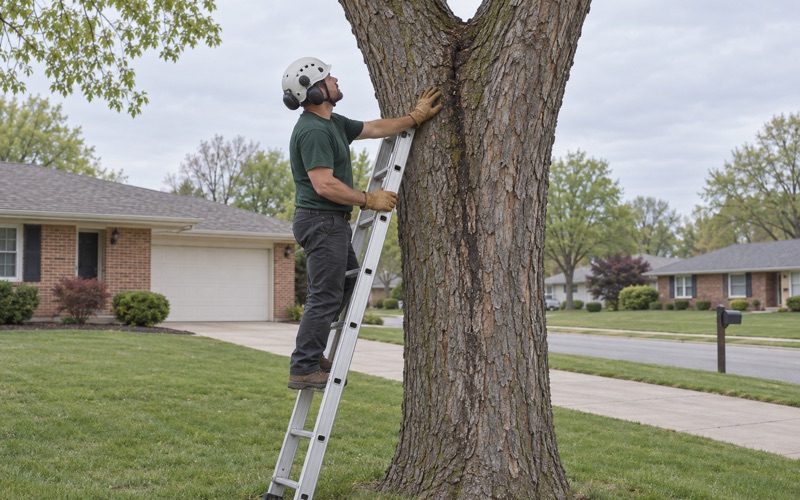
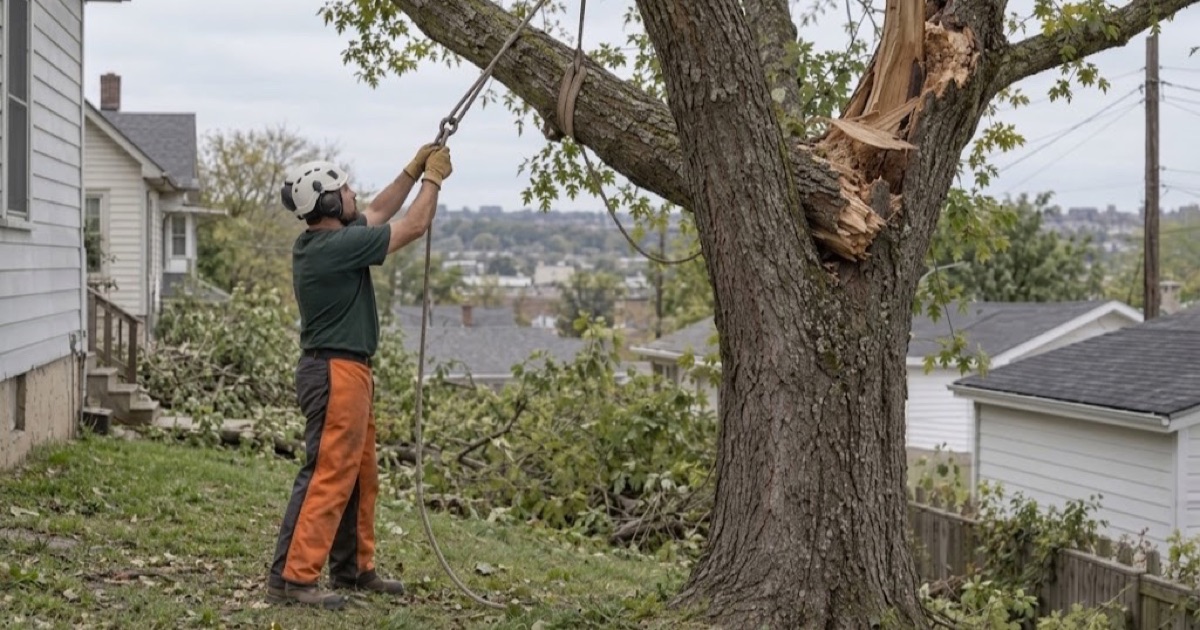
Straight-line wind loads a canopy from one side and holds it there, so the crown works as a sail and the failure shows up at the weakest union rather than at the trunk. Codominant stems joined with included bark are the standing candidate: the bark seam never knits into wood, and the union splits down the stem under load with a green, healthy-looking crown above it. We read that geometry first, measure diameter at breast height, and decide between a reduction, a cabling installation and a removal on what the union tells us rather than on how the tree looks from the street.
The prohibited list reads as a wind list
The city’s permitted and prohibited street-tree listing bars silver maple, Bradford pear, cottonwood, boxelder, willow and Siberian elm from the right-of-way, and from a tree crew’s seat that reads as an inventory of what comes apart in a gust. Those species are still standing in private yards across the city in real numbers, planted long before the listing existed, and they take a disproportionate share of the calls on the morning after a wind event.
The tree still standing is usually the expensive one
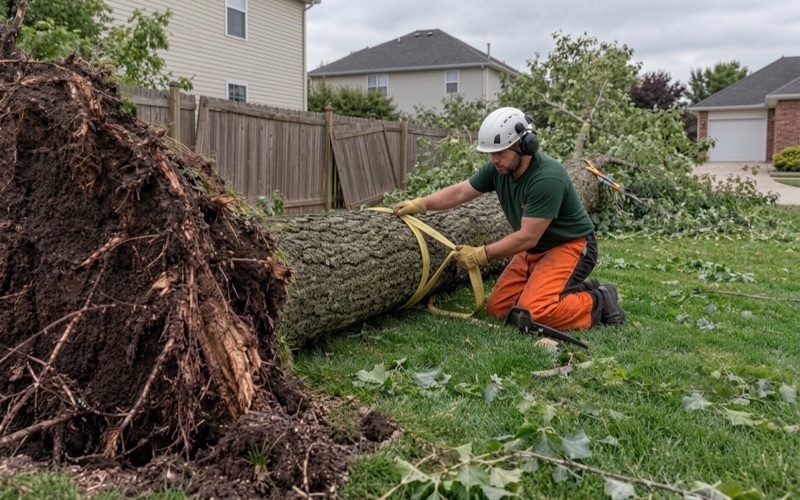
Most of what we remove after a wind event is not the tree that fell, it is the one beside it. A gust that takes one stem out of a two-stemmed maple leaves the survivor unbalanced, with a fresh split face open to decay and a crown that now catches wind from a direction it never had to resist. We walk the standing trees on a storm call before we price the one on the ground, and we say plainly when the wounded survivor is a second job rather than a bargain add-on.
Ice at an eighth of an inch, and the load it puts on a canopy
The other event that fills our winter schedule is glaze. The same forecast office titles its February 5 through 7, 2019 record as an ice storm affecting all of eastern Kansas and central Missouri at one-eighth to one-quarter inch of accretion, which sounds trivial written down and is not. Ice builds on the fine outer twigs first, so the added weight collects at the far end of every lever arm in the crown, exactly where a tree holds the least strength in reserve.
That is why an ice failure looks nothing like a wind failure. Wind finds the weak union, while ice finds the long, unreduced lateral limb that has been reaching for light over a roofline for thirty years. Trees carrying dead wood through the canopy shed it in the same event, which is why the cheapest useful work on an old tree here is crown cleaning done before the season instead of cleanup after it.
Reduction, not topping
Where a limb has grown too long for its own diameter we shorten the lever arm with crown reduction, cut back to appropriate laterals under ANSI A300, and we lift a canopy off a roof or a drive with crown raising done the same way. Topping is a different operation and we do not sell it: it strips out the load-bearing wood and replaces it with a mass of weakly attached regrowth that fails in the next storm anyway. Where a union is worth saving rather than removing, cabling and bracing with through-bolted brace rods can buy a good tree years.
The canopy over this housing is genuinely old
Much of the housing stock here predates the interstate era, with 48.08 percent of units built before 1960 and 20.83 percent standing since 1939 or earlier, and a good share of the trees over it are the same age. The upland forest native to this ground is oak and hickory, dominated by shagbark and bitternut hickory with red oak, white oak and black oak, and carrying Ohio buckeye, American bladdernut and pawpaw through the understory. A mature oak with a century of extension on it is a serious ice load to be hanging over a bedroom.
When ice decides the tree is finished
Glaze also settles the question of whether a tree is worth keeping. A crown that loses more than half its structure in one event rarely rebuilds into anything sound, and we would rather say so in February than take a pruning fee for a tree we expect to be removing in two years. Where the loss is one limb on an otherwise balanced crown, the tree usually comes back with a clean reduction and time.
What we look for before the season, and how the work goes
A pre-season inspection here is more than a walk-around. We work the ISA Basic Tree Risk Assessment Form, the same framework behind the Tree Risk Assessment Qualification, and it forces the assessment to name the target underneath the tree instead of grading the tree in the abstract. A leaning cottonwood over a back fence and the identical tree over a child’s bedroom are not the same finding, and the write-up says so.
Where a trunk reads suspect, with a cavity, a fruiting body or an old wound closing over decay, we go past the visual with a resistograph or sonic tomography rather than guessing at how much sound wall is left. Where the trouble sits below grade, an air spade and a root collar excavation show whether the flare is buried, girdled or rotting, and we keep machinery out of the critical root zone on any tree we intend to keep. Every one of those findings gets priced both ways when a tree can be saved rather than removed.
Taking one down over a roof
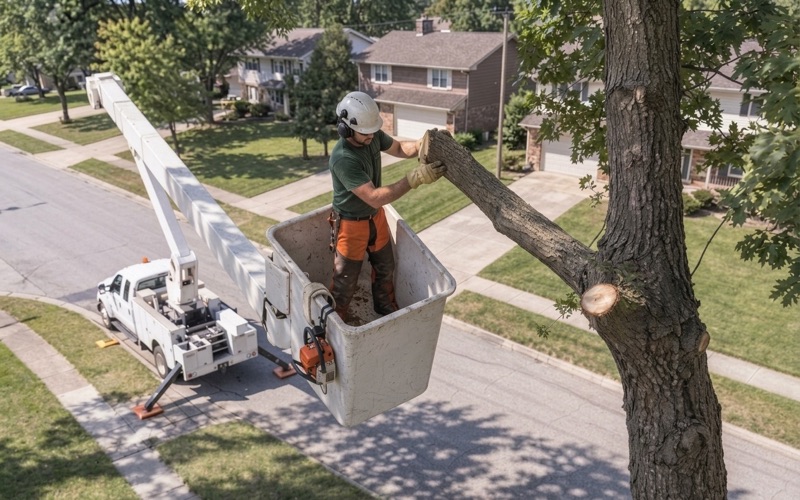
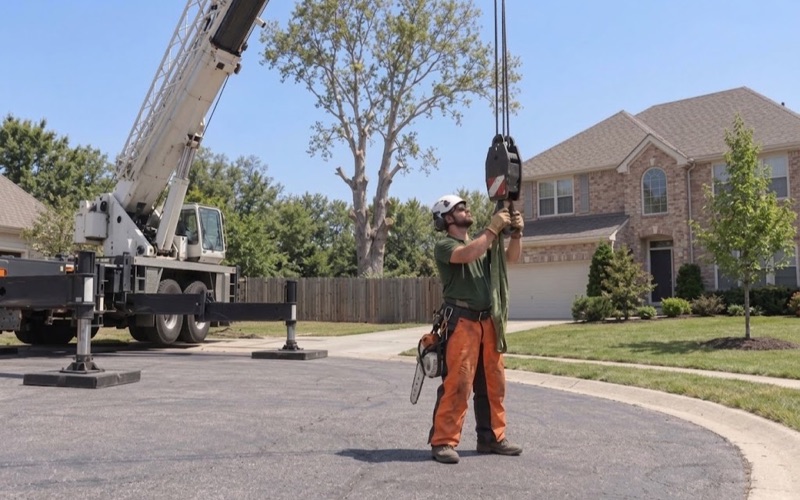
Dismantling a wind-damaged tree above a house is a rigging problem before it is a cutting problem. We lower pieces on a rigging block through a friction device rather than dropping them, use the three-cut method on limbs so nothing tears bark down the stem, and bring crane or spider lift access to the tight inner-ring lots a bucket truck cannot reach. A grapple saw earns its keep where a limb is loaded and nobody should be in it, and where a limb is lying on a conductor nothing starts until the utility confirms the line is dead, which is the boundary ANSI Z133 draws and we do not cross it for a same-day booking.
Stumps, cleanup and what the estimate says
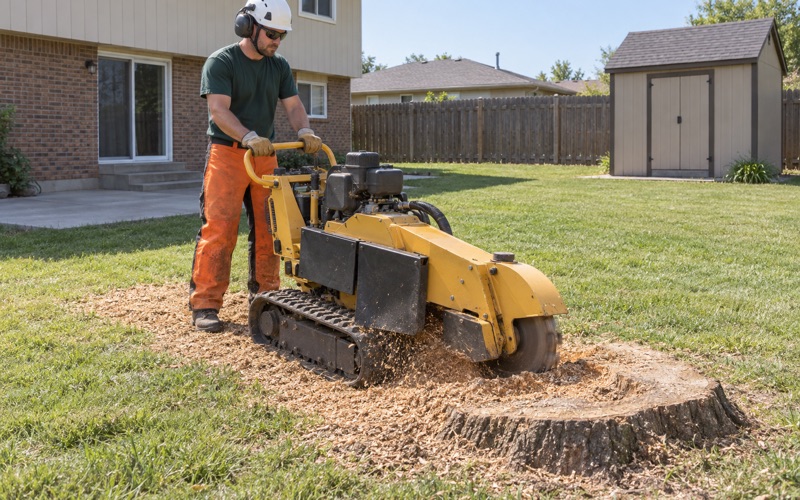
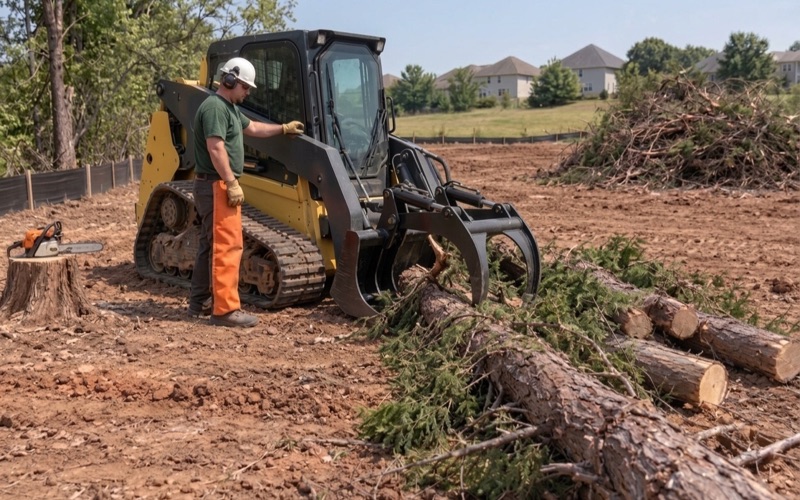
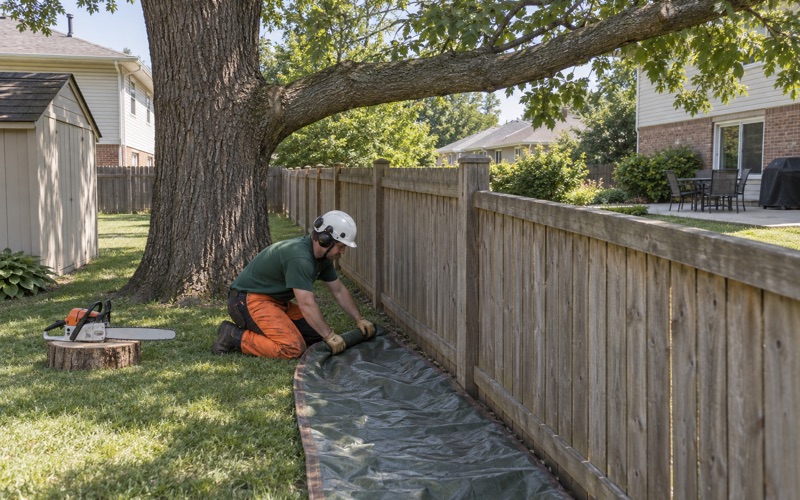
When a removal is the answer, the estimate states what happens to the stump and what happens to the wood. We grind rather than pull, because pulling opens a hole the width of the root plate and takes the surrounding grade with it, and we quote the finished depth after looking at the stump instead of promising a figure over the phone. Any grinding starts with a Kansas 811 locate, the debris leaves with us, and the site is left rakeable.
The yard decides the answer, not the city limit
Exposure changes street by street here, and so does the recommendation. A sheltered lot in Strawberry Hill or Rosedale behaves differently in a gust from open ground out toward Piper or the ridges above Wyandotte County Lake, and the same species carries ice differently in each. Walk the yard with us and we will say which trees are the risk, which are sound, and what each answer costs.
- Insured, Proof Provided
- 20+ Years in Johnson County
- Free Written Estimates