
Lenexa Tree Removal has been taking trees down in Gardner for more than twenty years, and tree removal in Gardner is about to carry a paperwork half it has never carried before. The Kansas Department of Agriculture’s Callery pear quarantine takes effect statewide on January 1, 2027, and it prohibits the sale and the movement of all seeds, plants or parts. For a garden center that is a rule about the sales floor; for a crew running a chipper and a dump truck it is a rule about what leaves your property and where it is allowed to travel afterward.
That is why we handle a Callery pear on a Gardner lot as its own line item rather than as one more medium hardwood. Every estimate we write names the tree, the method and exactly what cleanup is included, and on a pear the cleanup line has to answer a question about destination as well as one about price. Settling that in writing before a saw comes off the truck is cheaper for everyone than discovering it with a truck already loaded.
None of this says that a homeowner with a pear in the front yard is doing something wrong today. The quarantine is a future date with a specific scope, and the useful work right now is deciding how a removal on the far side of that date actually gets handled, priced and hauled.
January 1, 2027, and what a rule on movement does to a truck
Sale is the half that gets reported
Most of what has been said about the Kansas Department of Agriculture’s decision describes the end of Callery pear sales, which is fair as far as it goes, because that is the half that changes what a nursery may put out on a bench. Read only that way, the quarantine sounds like a rule for retailers carrying a footnote for everybody else. The wording is broader than that, and the broader part is the half that lands on a removal crew.
Parts is the half that reaches the job
The quarantine prohibits the sale and the movement of all seeds, plants or parts, and a removal is a machine for producing parts: brush, chips, rounds, and a stump with its roots still attached. From the effective date forward, the destination of that material becomes a legal question before it is a logistics question, and the answer belongs in a written estimate rather than in a conversation at the tailgate. We work both sides of State Line Road and have spent twenty years watching the rules change the moment you cross it, so we do not assume that a Kansas rule and a long-standing Missouri habit are the same thing.
In practice that means we identify the species during the walk-through rather than at the chipper. A Callery pear is flagged on the estimate as a Callery pear, with its disposal route named and priced, and if the route we would ordinarily use is not open to that species once the quarantine is in force, it shows up as a number on the page instead of as a surprise on the day.
The practical consequence for us is a routing decision made at the estimate rather than at the end of a long afternoon. A crew that has not settled where a species may lawfully go before the chipper starts is a crew improvising with a full truck, and improvising is how a disposal cost turns into an argument in somebody’s driveway. Two decades of Johnson County work has made us conservative about exactly this class of question.
Looking for tree-removal closer to Basehor? See Basehor Tree-Removal.
Grinding the stump is not the end of a Callery pear
Callery pear resprouts from lateral roots when only the stump is ground, so a removal that stops at the visible stump comes back as a thicket of shoots across the critical root zone. That is a species trait rather than a workmanship failure, and it is why a pear quote that looks identical to a maple quote of the same diameter at breast height is quietly the wrong quote. We say so at the estimate and price the follow-up into it, instead of leaving it as an unwelcome discovery in the second spring.
Following a pear past the stump means treating the root plate as part of the job rather than as landscaping to be sorted out later. We grind well outside the root collar rather than to the bark line, walk the surrounding turf for shoots rising off lateral roots away from the cut, and write the return visit into the same estimate that prices the takedown. The pruning and removal work itself is done to ANSI A300, under the crew safety practices in ANSI Z133, which is the least any homeowner should ask of a contractor quoting a tree here.
What the grinder can and cannot promise
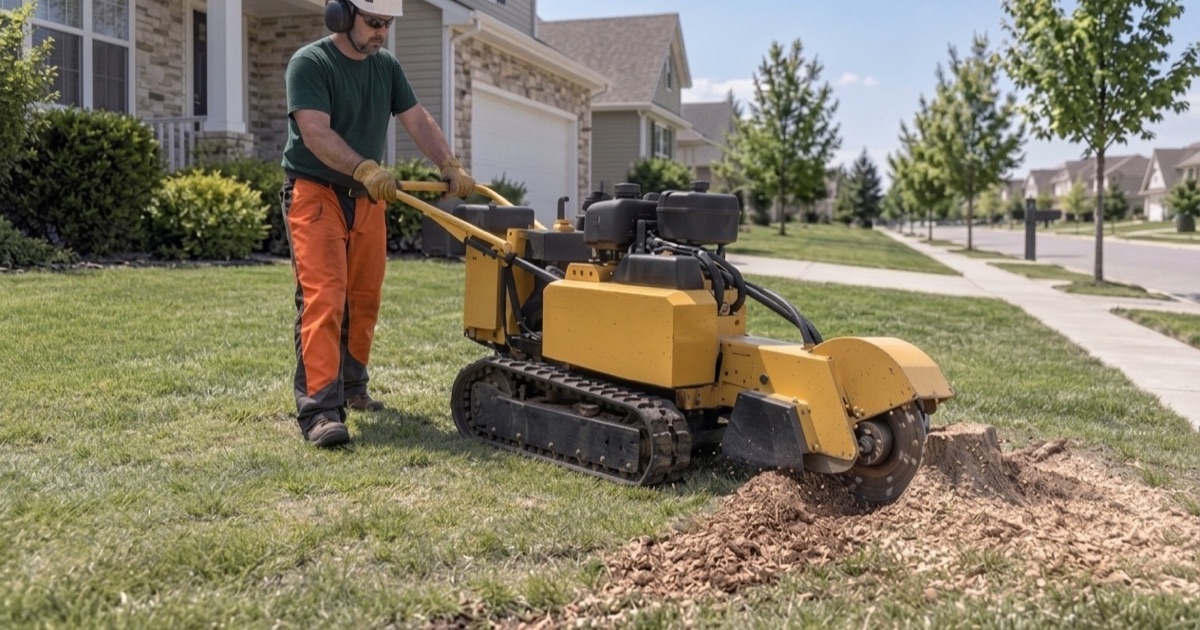
A stump grinder cutting wheel is rated for a below-grade cut of roughly 12 to 25 inches depending on the machine class, and no honest crew promises a finished depth sight-unseen. Across Johnson County the mapped soils run from Vinland at 10 to 20 inches to a paralithic contact through Sharpsburg with no bedrock restriction stated at all, so rock stops the wheel on some ground and never comes near it on other ground a few streets away. On a recently graded subdivision lot the working medium is imported fill and compacted subgrade, which the soil survey does not describe at all.
Before anything goes below grade
Kansas 811 gets the call before we grind, every time, under the Kansas Underground Utility Damage Prevention Act. Notice has to be served at least two full working days and not more than 20 calendar days ahead of the scheduled start, which makes it a scheduling fact as much as a safety one, and it is the reason a stump ground on the same visit as the removal has to be planned rather than volunteered on the spot.
What we ask about a pear before we quote it
Gardner’s housing stock is young, with 41.93 percent of it built between 2000 and 2009, so a great many of the trees coming down here are the trees that arrived with the house rather than legacy specimens. The county’s own extension brochure is blunt about one of them: “DO NOT plant Bradford cultivar; severe splitting occurs on 10-15 year old trees.” Most of that planting window is now well past ten to fifteen years, which is why so many of these calls open with a split union rather than with a dead tree.
The walk-through therefore measures the things that decide the method rather than the things that decide the adjectives. We record diameter at breast height, look hard for codominant stems and included bark at the union, and settle whether a limb comes down in a three-cut sequence off a rope or in rigged sections over something that must not be hit.
Wind is the load that finds those unions, and the National Weather Service office at Kansas City/Pleasant Hill logs this ground’s wind as squall lines and downbursts rather than as one famous storm. Its own record names the May 19, 2024 squall line that crossed Johnson County and continued into Platte, Jackson and Clay Counties with four brief tornadoes. A pear carrying included bark does not need a rare event to come apart; it needs an ordinary one on a night when the crown is wet.
Access, and why the chipper is the constraint
On most Gardner lots the binding limit is neither the crane nor the grinder. A compact grinder in the narrow-access class passes a 35-inch gate, while a Bandit Intimidator 19XPC is 7 feet 9 inches wide and 10,500 pounds and never goes through a gate at all. Knowing which side of the house the chipper can actually reach moves the labor line on an estimate further than the height of the tree does.
Not every caller here owns the tree, either, since 16.90 percent of Gardner’s housing units sit in structures of two or more and the person signing is often a manager or a board. Those jobs get the same written estimate naming the species, the method and the cleanup, because a manager has to hand that page to somebody else before it can become a purchase order.
Where the wood goes once it is on the truck
Johnson County will not take a trunk section at any price, since yard waste is barred from the landfill and the landfill caps landscape waste at 3 inches in diameter. The route that takes real removal wood runs to Missouri Organic Recycling in Kansas City, Missouri, at $10.00 per cubic yard for brush, accepting logs up to 40 inches in diameter if they are under 5 feet long and refusing stumps with dirt still attached. That last condition already shapes how we cut and clean a stump before it is loaded, and once the quarantine is in force a pear’s route is the first thing we settle rather than the last.
Replacement, and the one thing the state did not do
The Kansas Department of Agriculture expressly declined to list Callery pear as a noxious weed. That refusal is the most useful line in the whole file for a homeowner, because a noxious-weed listing is the mechanism that pushes landowners to act against a plant already established in the ground. What the state did instead reaches trade and movement, which leaves a healthy pear standing in your yard as a decision rather than as an obligation.
We treat it that way on site: when a pear is structurally sound and nowhere near a target, we will say so and price both the removal and the work that would keep it standing, because an estimate that only ever arrives at one answer is a sales document rather than an assessment. When the same tree is already splitting at an included-bark union above a driveway, that is a different conversation and the written estimate says exactly why.
For what goes back into the hole, Gardner sits in the Osage Cuestas, whose potential natural vegetation is upland forest dominated by shagbark hickory, bitternut hickory, red oak, white oak and black oak, with Ohio buckeye, American bladdernut and pawpaw common as understory trees. The same extension brochure that refuses the Bradford cultivar also refuses silver maple for weak wood, and its general warning earns repeating: “Many fast growing varieties are brittle with narrow crotch angles that can lead to severe breakage during storms.”
Whatever we take down, proof of insurance is in your hand before the work starts, the debris leaves with us, and the site is left rakeable rather than merely swept. Our crews are local ones on local roads rather than a franchise call center in another state, the price is set against what the tree is actually doing rather than against a clock, and when a tree is on a house or across a drive we answer the same day.
- Insured, Proof Provided
- 20+ Years in Johnson County
- Free Written Estimates









