
Lenexa Tree Removal runs crane assisted tree removal across Lenexa, KS, for the trees that have nowhere to fall. Twenty years of removals on lots in this city has settled a fairly simple rule for us: where the drop zone belongs to somebody else, the crane is not the expensive option, it is the one that does not generate a claim.
The geometry here makes that common. Nearly forty-four percent of the housing is attached or multifamily, and the detached stock that is in first removal cycle - the 1970s and 1980s cohorts, roughly a fifth of the city each - sits on lots with fences, decks, pools and a neighbor’s roof inside every plausible fall line.
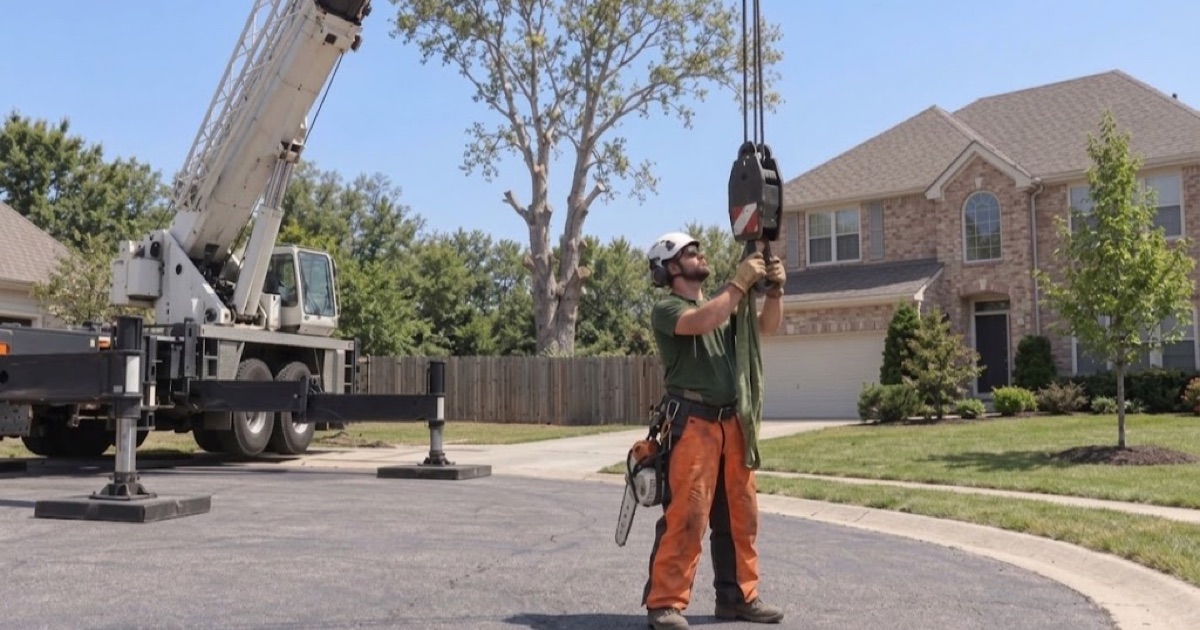
A crane changes the job from felling to lifting. Sections come off under control and go straight to the ground in a chosen spot, so nothing swings, nothing drags across a roof, and the tree leaves the property in hours rather than over a long day of rigging every piece down through itself.
When a Crane Is the Cheaper Answer
The Drop Zone Belongs to Somebody Else
On an inner-ring lot the honest inventory of a fall line is usually a fence, a deck, an air conditioning unit, a pool surround and a neighbor’s roof. Rigging every piece down past all of that is slow and it is where the damage happens. Lifting the same pieces out over the top removes the exposure rather than managing it.
The Tree Is Already Failing
Storm-broken wood does not behave predictably, and a compromised stem is exactly what you do not want a climber tied into. After the July 14, 2023 wind storm - 89 mph measured just west of this city, roughly 200,000 customers out - a great deal of the work was hung-up crowns and split unions, and those are picks rather than climbs.
The Day Count, Which Is the Real Cost
A crane removal usually runs to hours. The same tree taken down piece by piece from a rope can be a full day or two of skilled crew time, plus the ground work of hauling every section out by hand around the obstacles that made the crane worth having. On most tight lots the crane loses on the hourly rate and wins on the invoice.
Setting Up: Access, Bearing and the Street
Where the Machine Can Bear
Outriggers concentrate an enormous load into four small footprints, so setup is a bearing question before it is a reach question. Pads go under every outrigger, and we check what is under them - septic lids, cisterns, shallow vaults, a driveway spanning a void, and on the newer parts of the city, engineered fill that has never carried a point load like that.
The Right-of-Way and the Street
Most setups end up on the drive or in the street rather than on the lawn. Lenexa tells homeowners the right-of-way typically extends about eleven to fifteen feet back from the curb, which is the strip most crane work occupies, and where a lane has to be coned off we plan it for the quietest part of the day and keep the closure to the picks that need it.
Conductors Overhead
Nothing gets set up under a line without settling what the line is. The span from the pole to the meter is the customer’s responsibility under Evergy’s published rule, and because Evergy publishes no line-drop or disconnect service on this side of the metro, the pick geometry is planned around an energized conductor. Where a primary is involved, the utility is called before anything is rigged.
The Pick Itself
Rigging the Load Before Cutting It
Each section is slung and the crane takes the weight before the cut is finished, so the piece never becomes a falling object. That is the whole point of the method, and it is why the sequence and the sling positions are worked out on the ground first rather than improvised sixty feet up.
Keeping People Out of Bad Wood
A grapple saw takes the operator out of the tree entirely on the sections most likely to move unpredictably, which after a storm is most of them. On lots where a bucket truck cannot reach and a crane cannot get close enough for every cut, a spider lift tracks through a gate and spreads its weight across ground that would not take an outrigger.
Big Wood, and Where It Goes
Crane removals produce the largest material on any residential job, and the disposal gates have limits worth planning for. Missouri Organic Recycling accepts logs up to forty inches in diameter provided they are under five feet in length and refuses stumps with dirt, and the Johnson County landfill caps landscape waste at three inches in diameter.
Residential and Commercial Crane Removals
Established Lots in First Removal Cycle
Only 3.58 percent of Lenexa’s housing predates 1960, so this is not a city of hundred-year canopy - it is a city whose 1970s and 1980s trees are now forty to fifty-five years old and reaching the size where failure has consequences. Those are the crane jobs: large enough to matter, on lots built out to the edges.
Multifamily and HOA Grounds
With a large attached and multifamily share, much of this work is ordered by a board or a management company, where the constraints are resident parking, fire lanes and access for people who live there while the work happens. Those jobs get a written scope, a scheduled window and notice for residents rather than a crew arriving unannounced.
Business Parks and Logistics Sites
Lenexa carries one of the metro’s larger warehouse and business-park concentrations, and crane work there is scheduled around operations. Truck courts and dock aprons cannot be blocked in working hours, fire lanes have to stay open, and the site has to be swept and reopened the same day - so the pick plan is built around the site’s clock as much as the tree.
- Insured, Proof Provided
- 20+ Years in Johnson County
- Free Written Estimates