
Lenexa Tree Removal provides arborist tree risk assessment across Lenexa, KS, serving surrounding cities including Shawnee, Olathe, Merriam, De Soto, Edwardsville. Twenty years of removals and storm calls on this ground is what the assessment rests on: we have taken down the trees that failed here, which is a different kind of knowledge from reading about the species.
The city puts the duty squarely on the owner. Lenexa states that a dead or dying tree on your property is your responsibility to remove before it becomes hazardous, and it directs residents to insured contractors with certified arborists on staff. What the city does not do is tell you which of your trees qualifies, and that is the gap an assessment closes.
An assessment is not a sales visit with a clipboard. It produces a written record naming the tree, its defects, the targets beneath it and a rating with a timeframe attached, so the decision to remove, to treat or to leave it standing is one somebody can defend afterward - to an insurer, to a neighbor, or to a board that has to approve the spend.
What a Tree Risk Assessment Actually Measures
Likelihood That the Part Fails
The first term is mechanical: how likely is this specific part - a stem, a scaffold limb, the whole root plate - to come apart within a stated period. That is read from the defect itself and from the load it carries, not from how old or how large the tree happens to be, and a sound eighty-foot oak can rate lower than a brittle twenty-year-old pear beside it.
Likelihood That It Reaches Something
A limb that fails over open lawn is not the same problem as the identical limb over a driveway used twice a day. The second term is target occupancy: what sits inside the fall zone, and how often somebody or something is actually there. This is why the same tree gets two different ratings on two different lots, and why moving a parking space sometimes beats removing a tree.
Consequences, and the Rating They Produce
The third term is what the impact would cost - a bruised fence, a punctured roof, a service drop torn off the meter. Combining the three gives a risk rating rather than a verdict, and the rating carries a timeframe. That structure comes from the framework the International Society of Arboriculture built around its Tree Risk Assessment Qualification, and the ISA Basic Tree Risk Assessment Form is the record it produces.
Assessment Levels, and Which One Your Tree Needs
A Limited Visual Look Across Many Trees
The lightest level is a fast visual pass, usually from the ground and often from a vehicle, over a population rather than an individual - a street frontage, a business park, an apartment community after a wind event. It finds the obvious failures and the trees that need a closer look. It is a triage tool, and no report from us will present it as more than that.
A Basic Assessment of the Individual Tree
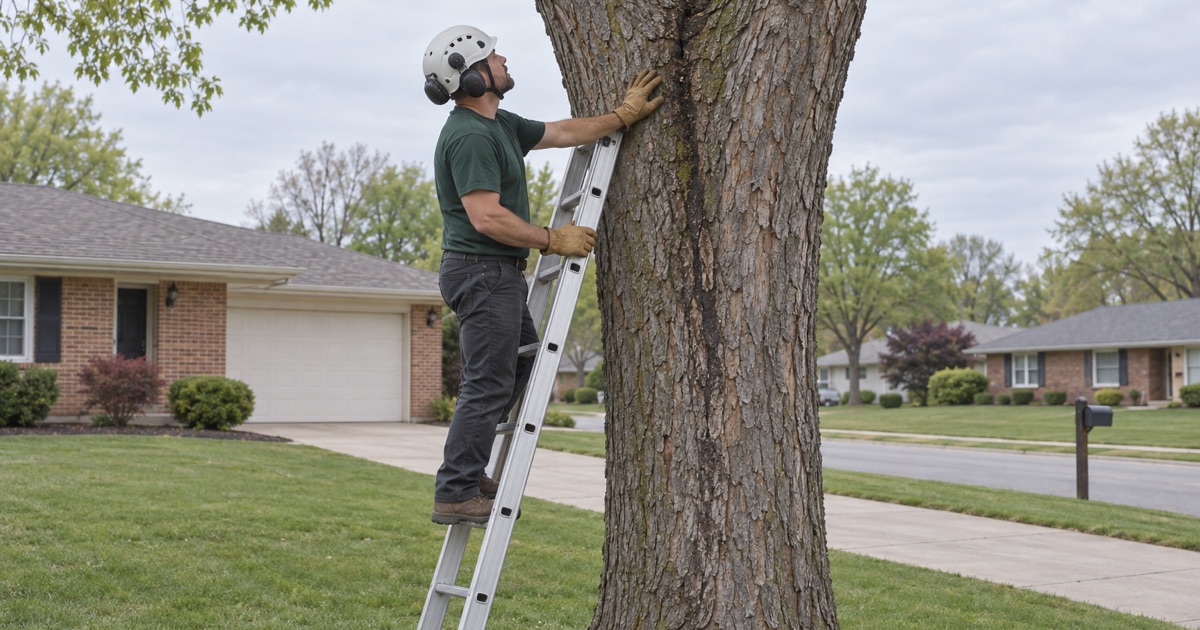
This is the standard product and what most Lenexa properties need: a walk-around of the whole tree, the root collar and the ground around it, a look up into the crown with binoculars, a sounding mallet where decay is suspected, and diameter at breast height recorded so future readings mean something.
The defects go on the form with their location and extent, the targets are recorded, and the rating comes out the other end. Where the basic assessment cannot settle a question, it says which advanced test would.
An Advanced Assessment When the Answer Has to Be Certain
Advanced work is instrument work, and it is used on the trees where removal is expensive or the tree is worth real money. Sonic tomography times sound across the stem to map internal decay without cutting it; a resistograph reads drilling resistance through a fine probe to measure a wall of sound wood; root collar excavation with an air spade exposes the flare so girdling roots and buried decay can be seen rather than guessed at.
The Defects That Show Up on Lenexa Trees
Codominant Stems and Included Bark
Two stems of near-equal size compete rather than one dominating, and the union between them carries both. Where bark has been trapped in that union instead of wood, the joint is a seam and not a weld, and included bark is what turns an ordinary codominant fork into a failure waiting on a wind event. Finding it is what moves a tree from a single cable to a cable-and-brace-rod system.
Root Plate, Buried Flare and Trenching Damage
More trees fail from the ground up here than owners expect. A trunk entering the soil like a post, with no visible flare, is usually buried by fill or grade work, and roughly 21 percent of Lenexa’s housing was built in 2010 or later on engineered fill and compacted subgrade. Recent utility trenching through the critical root zone is the other finding, and it does not show in the crown for years.
Species That Fail Early, and the Storm That Finds Them
The Johnson County extension service is blunt about this: many fast-growing varieties are brittle with narrow crotch angles that lead to severe breakage in storms, and its Bradford entry warns that severe splitting occurs on ten to fifteen year old trees. It also attaches ice caveats to river birch, lacebark elm and sweet gum.
The storm record is what tests them. The National Weather Service measured 89 mph just west of this city on July 14, 2023 with roughly 200,000 customers out, and recorded an ice storm across eastern Kansas in February 2019 at one-eighth to one-quarter inch of accretion.
Commercial and Residential Assessments
Residential Lots in the First Removal Cycle
Only 3.58 percent of Lenexa’s housing predates 1960, but the 1970s and 1980s cohorts are around a fifth of the stock each and their trees went in with the houses. Those trees are reaching the age where the defects become structural rather than cosmetic, on lots where a failure lands on a deck, a fence, a pool or the house next door.
Homeowner Associations and Multifamily Communities
Nearly forty-four percent of the housing here is attached or multifamily, which means a board or a management company owns the tree risk rather than a resident. Those clients need an inventory with per-tree ratings and a mitigation schedule that can be budgeted over years, not a single opinion delivered after something has already come down.
Business Parks, Warehouses and Logistics Sites
Lenexa carries one of the metro’s larger business-park and warehouse concentrations, where grounds work is a common-area line reconciled annually. On those sites the targets are truck courts, dock aprons, employee parking and roof membranes, and the assessment is written so a facilities manager can move it straight into a capital plan.
Our Step-by-Step Tree Risk Assessment Process
1. Scope the Trees and the Targets
We agree in advance which trees are in scope and what counts as a target, because a rating with no named target is meaningless. On a residential lot that is a short conversation; on a commercial site it means walking the property line, the parking and the pedestrian routes first.
2. Inspect From the Root Collar Upward
Every tree is worked from the ground up - soil and root plate, root collar, trunk, unions, scaffold limbs, then the outer crown. Diameter at breast height is recorded and each defect is located and measured rather than described in adjectives.
3. Test Only Where the Question Is Real
Advanced instruments are used where the visual assessment leaves a genuine question and the answer changes the decision. Tomography, resistograph readings and air-spade excavation cost money, and we will not run them to decorate a report that had already reached its conclusion.
4. Rate, With a Timeframe Attached
Likelihood of failure, likelihood of impact and consequences combine into a rating that names the period it applies to. That timeframe is the part people skip, and it is the part that decides whether a tree gets reassessed next spring or in three years.
5. Price Every Option, Including Doing Nothing
The report closes with what can be done and what each option changes: crown reduction, cabling and bracing, root collar excavation and decompaction, target relocation, monitoring, or removal. We price the treatment beside the removal so the numbers argue, rather than presenting the removal as the only line on the page.
- Insured, Proof Provided
- 20+ Years in Johnson County
- Free Written Estimates